The Man My Father Was and Is

My wife and I just got back from Georgetown, Texas, the town I grew up in and the place my father and stepmother still call home.  And now, this Sunday morning, I’m looking inward, to see what sort of thoughts bubble up about this recent visit with two people I’m very close to.

I feel that there’s a story I want to tell this morning about the visit.  There are thoughts, some tinged with a sense of melancholy, that need getting down and organizing.

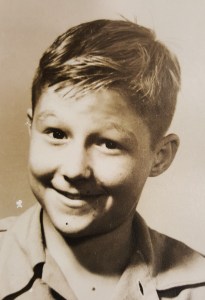
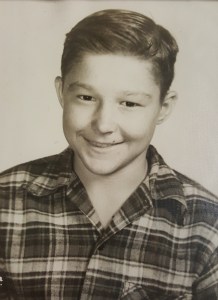
Earlier this week, days before we took off to Georgetown, my father was much in my thoughts.  This preoccupation was triggered when I got into a box of old photos and found two of him that were taken when he was just a boy.  I spent a long time holding those pictures in my hands and looking at them.  They were likely taken in the early to mid-1940s, at a time when a great war raged and the world was a much different sort of place.  Today, in 2018, my father is an octogenarian, but I can still see signs of that boy when I look at those images.
 

Last night, I sat across the dining room table from my father after dinner and while the dishes were being cleared.  As often happens on such visits, I prompted him with questions about what his life had been like decades ago.  He often complains about how bad his memory has gotten, but he somehow always manages to recollect past events, in minute detail, and then share them.

“Did I ever tell you about Billy Dowdy?” my dad asked as he removed his glasses, an act which allowed him, I suppose, to see way back.

“I don’t think so,” I answered.

“So you didn’t know Billy Dowdy?”

Janie, my stepmother, said, “Roy, he couldn’t have known him.”

As it turns out, Billy Dowdy was a man several years younger than my father.  He’d grown up in a little shack of a place that was located in a field behind my father’s boyhood home and not far from the San Gabriel River, a vein of blue-green water that the two youngsters knew well and swam in together.

In 1953, after finishing high school, my father joined the US Air Force and was sent overseas, for four years, to places like Guam and Japan, to learn and send messages in Morse code.  Before being shipped off to those faraway places, he recalls saying goodbyes to everyone he’d ever been close to.  Of course, Billy Dowdy was one of those who’d received such a farewell.

In 1957, when dad had completed his military service, he returned to Georgetown and went to see Billy, to let him know that he was back in town.  Much to my dad’s amazement, Billy, the boy, was now Billy, the alcoholic man.  He’d aged more than four years could account for.  Dad recalls that his boyhood buddy now carried a bottle with him wherever he went and that he would take his first swig immediately upon waking up and wouldn’t take his last until the booze ran dry or he’d pass out.  Where had Billy, the lad full of life and possibility, gone off to?

My father liked to party too, and sometimes he’d pick Billy up in his old roadster and the two would go honky-tonking together.  Dad remembers how his boyhood companion could sing exactly like Hank Williams.  He had a beautiful voice, and my father would drive and listen to Billy sing those sad cowboy songs as the two moved through the dark night with the windows rolled down and the breeze ruffling their combed and oiled hair.

Billy got arrested a lot and died in the Georgetown jail.  That was how Billy’s story ended.  It was also the point my father stopped telling it.  He put his glasses back on and looked down at the table.

When he looked back up again, he asked, “How had Billy gone from what he’d been to what he’d become in four short years?”  Such a transformation was beyond my father’s understanding.

I’m sitting here thinking about the question my father asked and how universal it is.  How have any of us become the people we are now?  How much of all that was by choice and how much was outside our human control?


Portals

people-sign-traveling-blur

I miss airports. I know that might sound like crazy talk to those who travel, via air, all around these United States on business trips and therefore find themselves rushing from one terminal to another and one departure gate to another. It might sound like kookiness to other classes of people too. That’s possible, even probable. But to know how I lived for two decades of my life is to understand why I miss airports.

Facts are always important, so I’ll throw a few out there. I have flown over the Atlantic Ocean somewhere around forty times, and I have cruised, at thirty-something thousand feet above sea level, over many smaller bodies of water too. I have lived and worked in five countries—America, Poland, the United Arab Emirates, Turkey, and Egypt—located on four of the seven continents. If my count is correct, my two size-eight feet have tread across the soil of twenty-three nation-states, and planes have taken me to all of them. Ergo, I have been in many airports of the world and have developed a great fondness for such magical buildings.

I don’t use the word “magical” casually.  If you think about it, airports are portals.  A traveler steps into one, boards a flying behemoth, defies the law of gravity by lifting off terra firm, only to be deposited in a new place quite far away from where one started.  At the airport where one departed everyone was speaking English.  And then, when one disembarks, halfway around the world, people are mostly using Turkish or Chinese or Tagalog.  Such dramatic changes are jarring and they have a tendency to wake one up out of the deepest of metaphorical slumbers.  Then there’s the jetway, the most magical of magical places.  The jetway, leading to the plane, is something like an umbilical cord, though the analogy is not perfect.  Once inside the womb of the jumbo jet, one is connected to mother earth.  At liftoff, that connection is broken and one finds himself as disoriented as a newborn.

Though I am in love with airports, I’ve never been that wild about airplanes. It’s not my idea of fun to strap myself into a glorified tin can and hurtle through time and space at hundreds of miles per hour and tens of thousands of feet in the air. Airports, on the other hand, are a different story. Airports are hub spots and make great metaphors. For example, they are hives where planes gather and live. People, like bees, buzz through these great hives too.

Though I had taken short flights from one city in America to another even as a boy, my real experience with airports began in 1994 when, after an incredibly strange series of events, I went around a bend in the road of my life and joined the Peace Corps. The US government, after looking at all my paperwork and interviewing me on the telephone, decided to send me to Poland to do educational consulting work and teacher training.

We soon-to-be Volunteers flew out of JFK International Airport in New York. If NYC is the world, in microcosm, then JFK International is a condensed version of that metropolis. Up until ‘94, I was a rural, small-town guy and a mere amateur when it came to traveling. In JFK, I saw, for the very first time, the peoples of the planet, gathered together in all their infinite variety, and was thrilled to death by the spectacle. It was one of those moments—they come on rare occasions—when the eyes behold something of great wonder and portent.

Many hours after getting airborne, we landed in gloomy Warsaw and disembarked at Okecie Airport.  Poland’s largest portal seemed tiny and poor by comparison to JFK. The Poles we encountered there seemed tired, world weary, very Old World, and fascinated by all the Americans suddenly in their midst. I recall that the locals spoke a language full of soft sounds and unapologetically smoked while we waited for our baggage to come around the carousel.  In airports, travelers get that first jolt of culture shock.  The newness of a new place walks right up to you and gets in your face.

Schiphol International Airport, in Amsterdam, is probably my favorite facility of its type in the world; although, I would give honorable mentions to Barajas Airport in Madrid, O’Hare in Chicago, and the International Airport in Dubai.  I also have a very fond recollection of sitting at a tiny bar that was located near my departure gate in Houston’s George Bush Intercontinental.  I recall that I was ordering the most exotic bottles they had and emptying them like a real pro.  I was the bartender’s only customer so he had time to talk.  I can’t really recall where I was flying off to, but it was probably Egypt.  He was very curious about North Africa and Islam and I had time to teach him a bunch.

Back to Schiphol.  I have been in that airport probably ten times and have taken the train—the station is just below the ground floor—into the city six or seven of those times. If you do so, you end up right at the main train station in the heart of the old city.  The train doors slide open and one exits the building only to be confronted by the grandeur and magic of Amsterdam.  Come to think of it, train stations are places of great wonder too, and I have been in many throughout Europe and in parts of Asia.

I have had long layovers in Schiphol. Because of such waits, I have had the opportunity to rent hotel rooms, inside the airport proper, on at least two different occasions. (Most recently, in 2009, I stayed in a postmodern place called Yotel and have vivid recollections of how the hallway leading to my room was lit by purple neon, giving the place a kind of Star Trek feel.)  I know Schiphol so well and find it so inspiring that I would easily choose to live there if I were rich enough and free enough to be able to make that happen.  I know that sounds like the ravings of a lunatic, but I assure you that I’m speaking the truth.  I would actually TAKE UP RESIDENCE inside Schiphol Airport if I were younger and freer and had deeper pockets.

Moving freely around the world and passing through airports is now in my past. My Egyptian wife and I have decided, for a whole bunch of reasons, some of them political, to settle, at least for the time being, in the fascinating city of San Antonio in Texas, USA.  We are doing what some call “putting down roots.”  In my former life, I was in international education and thus had the sort of free time which gave me ample opportunity to travel. Today, on the other hand, I’m working in educational administration and don’t have as many vacation days as I once did. In fact, I haven’t stepped foot inside an airport, as a traveler, since the summer of 2015. That’s a real change in my way of being.

On some day of great import, we’ll pull up these roots and become vagabonds again. When that happens, it won’t take me long to adjust to my old ways. After all, travel is a big part of who I am even if that part of me is now dormant. And the airport, that place that appeals to the dreamer in me, will once again become the closest thing I’ll have to a home.

This Morning’s Commute

commuting

I opened the front door and the cold hit me.  I stepped out into it.  The sun was just coming up in San Antonio, and the outside colors were muted and tending toward the grayscale.  We live a short distance away from Loop 410, the Alamo City’s inner ring road, and I could hear, even as I walked down the sidewalk toward the truck, a roar—the collective voice of a million cars being pushed along by human beings.

It was cold as I slid into the seat, closed the door, inserted the key, and fired up.  I shivered, blew steam from my mouth.  I punched a button that would, in a few minutes, get heat going into the cab.  The truck was ready now, so I released the handbrake, put it in reverse and left.

I know a way to avoid the nearby school zone.  San Antonio is a big city that is filled with people, many of whom have children.  For the commuter, school zones mean slowing down and pausing for buses and children crossing streets.  For the commuter, these delays are maddening.  What we commuters turn into, at 7 a.m., is something single-minded and harried.  We curse those things we would normally tolerate.  We become something other than what we naturally are.

There is a moment, shortly after I turn off Marbach Road, when I can see the on-ramp to Loop 410.  I punch it then and my machine, made by the Nissan Corporation, makes a guttural sound.  I feel like an astronaut in the early moments of liftoff.  The force of acceleration pushes my head back as I rocket toward the great flow of vehicles.

I know this route and routine well.  I am one of a million now, jockeying for position, weaving in and out, and watching for signs of danger.  We are heading south.  Soon, I will make the big eastward turn and the sun, just peeking above the horizon, will cause me to squint.  The sky is becoming more interesting, moment by moment.  I would love to spend more time studying its shapeshifting clouds and nuanced colorations, but I have to remain wary.  Surrounded by these machines, madness, and speed, anything, at any time, could happen.

We pass by all sorts of landmarks, including the factory that puts out plumes of steam or something else.  The place produces God knows what.  It marks the moment we turn toward the east, and I adjust the visor to keep my eyes shaded.  What I am witnessing now, all around me, in this great flow of machines, is the human condition writ large.

I eventually take the Palo Alto College exit and the frenzy dies down.  I have a left turn to make and then two right ones.  A sign tells us we may drive our machines at forty miles per hour but no faster than that.  I make those turns and then pull into a lot where I turn the key in the ignition, putting my machine to rest.  Its engine pings and pops as it begins to cool down.  It will spend the next few hours resting up and preparing to carry me home as the day moves from light to dark.

I envy my machine as I step away from it.  It’s now my time to roar.

Charles Bukowski Currently Teaches English at Starbucks

charles-bukowski
The Real Bukowski in All His Glorious Madness

Last Saturday I met Charles Bukowski at a Starbucks in a Barnes and Noble bookstore in San Antonio, Texas.  He was arriving just as my wife and I had finished up our coffees and were gathering our belongings to leave.

Because he could see that we were getting ready to take off, he walked right up to us and asked, “Are you finished here?”

“Yes,” I answered as I stared at his acne-scarred face and misshapen nose—the bulbous proboscis of a wino.

“I ask because you’re at my favorite table, and I want to claim it if you are leaving.”

“You can put your stuff here if you’d like while we get ready to head out.  By the way, has anyone ever told you that you look exactly like Charles Bukowski?”

“Charles who?” he asked gruffly.

“Never mind.”

In fact, he was a spitting image of the renegade poet-madman-drunkard.

Because we’d bought books and had to put on coats and scarves to gird ourselves against the cold, it took us awhile to get our stuff together.  During this period, a conversation began to blossom.  “So you come here often?” I asked him.

“Every Saturday.  You see, I’m retired, but I give private lessons on the side to people who want to learn English.  Right now, I’m working with three young girls from Djibouti.  I always teach them at this particular table.”  After saying this, he leaned in to me and whispered, “Their English is very weak.”

Azza, my wife who speaks Arabic as her mother tongue, is not really a shy person, but she sometimes has a hard time inserting herself into a conversation between Americans when they are speaking a hundred miles an hour.

“I bet they’ll learn very fast, though,” I told him.  “They will probably be better at learning our language than we would be at learning theirs.”

“Maybe.  But who would want to learn whatever it is that they speak?”

“Ask them to speak their language to you and really listen to what they say.  I bet what you hear will sound beautiful if you open your ears and mind.  It’s my opinion that more Americans should learn a second language.”

He kind of frowned and then said, “So many people from crap countries want to come here.  They are just flooding in.  They have to learn English because it’s the lingua franca.”

I could feel the hair stand up on my neck.  Only days earlier, Donny Trump, the Hairpiece, had called African countries “shitholes.”  I had the feeling this old fart was likely a Trumper, and a part of me wanted to snarl.

“By the way, I’d like to introduce you to my wife, Azza.  She’s from Africa.  Her country and the people who call it home are beautiful in many ways.”

“I’m sure it is and that they are,” he said a touch snarkily.

“I think Americans should be a little more careful about judging others.  Don’t you think this country has its share of problems?” I asked him.

“Compared to other places, America is el paradiso,” he said, suddenly shifting to a foreign language.  “By the way, where, in Africa, is your wife from?”

“Egypt,” she said, finally asserting herself.

The man’s face suddenly changed and he started speaking Arabic to her.  As it turns out, he was born in Egypt and lived there as a child.  He asked her where, in “Misr,” she was from, and she said Cairo.  He, as it turns out, had been born in Alexandria.

From that point forward, I faded into the background because the language shifted to Arabic.  At one point, he asked her what her religion was and she said Islam.  He then called himself a “Yehudi,” which means “Jew,” and explained that this fact had played an important role in why his family left North Africa.  He shared some stories about how they had been victims of religious persecution under President Gamal Abdel Nasser.  Hearing these personal accounts saddened my wife.

We ended up talking until his three students showed up.  They were sweet girls.  Before they arrived, we found plenty to laugh about—the irony of an Egyptian Muslim and Jew meeting at the same table in a Starbucks at a Barnes and Noble bookstore in San Antonio.  We were reminded how small the world really is and how big it is too.  And how much we have in common despite our superficial differences.


A Third-Rate President


were n egypt
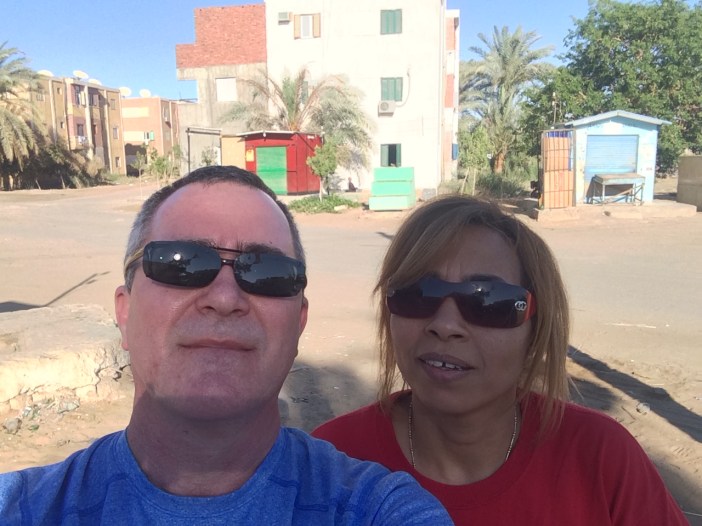
In Wadi Gedid, Egypt

I have a tendency to go on and on when I blog, but I want to be short and to the point on this one.  I am an American man who couldn’t be prouder to be married to an émigré from Egypt, an African country and one of those places the “President”—I don’t find him one bit presidential so I’m required to use quotation marks—recently besmirched by referring to them as “shitholes.”

I am proud because my wife is kind, honest, hardworking, creative, and generous, just to name a few of her positive attributes.  I find it ironic that a day after the “President” belittled those who’ve come here from other places, my wife completed the paperwork needed to start her own sole proprietorship, a home baker business she’s calling “ZooZoo’s Sweet Treats.”  She owned and operated such an enterprise in Egypt and did very well, mostly because she is an artist in the kitchen and a skilled entrepreneur.  I expect that she’ll be a smash here as well.

By the way, has the “President” seen this country in its entirety?  There are places in these United States that could use a little enrichment and beautification.

Why, one wonders, did Trump choose the term shitholes?  He could have referred to locales in Africa and such as “beautiful places,” but he didn’t.  He used such a descriptor because he thinks of large swaths of everywhere else as the “Third World” which equates to “third-rate.”  (Unfortunately, this whole “first-world-versus-third-world way of thinking is widely held in America.)  Those from the Third World are thought to be third-rate because they are poor and backward, which says a lot about what Americans put value on.  Such a way of looking at the world fails to take into account the fact that many in the Third World are actually first-rate when it comes to their spiritual development and the like.


A Tart to the Heart

Azza
Azza

Often, when people find out that I’m married to a woman from Egypt, they ask me, “So, how did you two meet?”  The following is the story of how I came to know my lovely and talented wife.

***

I’ll never forget the first time I laid eyes on Azza.  It happened on a hot April day in Cairo in 2011.  Only months earlier, in January to be precise, the famed Egyptian Revolution, the upheaval which would result in the overthrow of Hosni Mubarak, Egypt’s long-time dictator, had kicked off and the nation was still jittery and recovering from those cataclysmic events.  Anyway, on that fateful April day I happened to have a day off—I’d come to Cairo in August of 2008 to teach at the American University in Cairo—and was working out at the gym at the Community Services Association, a hangout for expats and English-speaking Cairenes.  I finished up, toweled the sweat off my body, and left.  On my way out of the compound that housed the gym, coffee shop, café, and other CSA facilities, I passed by a group of tables where several women were selling international dishes.  Behind them, on the wall they’d positioned themselves in front of, was a big placard that read “Cook’s Day Off.”

I was intrigued so I stopped to have a look.  The first woman I happened to notice was someone who looked to be from the Indian Subcontinent.  She spoke up and said, “Would you like to buy my Indian food?”

“Maybe.  What is all this?” I asked, waving my hand to refer to the spread of food on the tables in front of me.

“We’re with Cook’s Day Off.  We sell international food here at CSA twice a week.  These are small-sized portions for you to eat when you get home this evening or you can stock your freezer with them.”

“I see,” I said, and then I noticed that there was an Asian woman selling food from Thailand and someone—she didn’t look Italian—hawking perfectly packaged smallish portions of various raviolis and lasagnas as well as tiramisu and some other things I was not able to immediately identify without reading the attached labels.

I began to pace back and forth in front of the tables and look down at all the varieties of food.  Suddenly, the woman selling Italian spoke up and asked, “Do you like ravioli?”

“I do,” I said, and then, for the very first time, I looked directly into her eyes.

“Are you Italian?” I asked, thinking, all the while, that she was stunningly attractive.

“No.  I’m Egyptian.”

“But you cook and sell Italian?”

“Yes, because I was trained by an Italian chef and partnered with her in the past.”

“I see.”

In the end, being the bachelor that I was and perfectly helpless in the kitchen, I bought a little bit of everything, including two packages of spinach ravioli and two Italian tarts that featured chocolate.

On the way home, I couldn’t get the Egyptian woman out of my mind.  I started thinking about how wonderful it would be to go out with her on a date, but how would I ever get to know her name or find a way to make contact with her?

I was on foot, and I suddenly stopped on the crowded sidewalk.  People began to jostle into me but I took no notice of them.  I reached into the Italian bag and retrieved one of the tarts as I remembered that each package bore a label.  I took off my glasses and brought the tart up close to my face so that I could read the fine print right below the production date and list of ingredients.  Right there, in black and white, were the words “Azza Omar” and a telephone number.  That discovery prompted a huge smile to turn up the corners of my mouth.

I put the tart away and rushed home.  As soon as I got inside my apartment, I popped the plastic cover off the tart and cut a slice which I immediately crammed it into my mouth.  A plan was forming while I chewed.  Immediately upon swallowing, I took out my mobile phone and looked at the label again.  I then composed the following text:  “Hi.  My name is Troy.  I just bought two of your chocolate tarts.  As soon as I got home, I tried one and it was great.  Thank you.”  I clicked send as soon as I’d checked it for grammar and spelling errors.  I then began to pace back and forth in my kitchen.  In about two minutes, she responded, “You are welcome.”

***

Three weeks to the day after buying tarts from Azza and then texting her, I was sitting in front of my computer in my office on the campus of AUC.  My phone was sitting next to me and it rang.  When I looked down and didn’t immediately recognize the number, I let it ring until the caller eventually hung up.  I had a class to teach in about an hour and was busy prepping for it, so it was easy to ignore the call I’d just gotten.  A few minutes later, my phone rang again.  It was the same number belonging to the same unknown person.  I sighed and then decided to answer it.  “Hello,” I said.

“Hi.  May I speak with Troy?”

“This is Troy.  Who am I speaking with?”

“Azza.  You bought some of my Italian food two or three weeks ago.”

“Oh, hi, how are you?”

“I’m fine.  And you?”

“I’m good, thanks.  I’m sorry but I’m at my work today and won’t be able to come to CSA to buy any of your goodies, but I promise that I’ll come soon and get some more.”

“Actually, I’m not calling about my food.  I just wanted to say hello and to see how you’re doing.”

“Really?  You’re calling to say hello?”

“You seemed like a nice person when we met, so I thought I would see how you’re doing.”

“You seemed nice too.  Hey, would you like to meet in Maadi sometime for coffee or a Coke or something?”

“I’d really like that,” she said.

“I’d like it too.  How about this coming Thursday at six or seven in the evening?  Would that be a good day and time for you?”

“That would be great.  As it just so happens, I’ll be in your neighborhood at exactly that time to deliver an order to a customer.  I also cater and do a lot of parties, especially for Italians.”

“That sounds interesting.”

“It is.  Anyway, Thursday evening is fine.”

“Great!  Let’s meet at CSA then.”

“CSA is perfect.”

***

So, that’s how things got started between the two of us.  The rest, as they say, is history…


I’m Pretty Sure I’ve Been Here Before

Life takes some incredible twists and turns.  About a million years ago, I was born in San Antonio, Texas, a city that’s a little bit America and a little bit Mexico, and then, back when I was still pooping in diapers, mom and dad carried me off to Garland, a suburb of Dallas.  Over the decades, I have had one or two opportunities to return to my birthplace, but only as a tourist and only for very brief visits.  Mostly, I’ve been estranged from the locale that could rightfully be called my hometown.

Then, in the latter days of September of 2015, a few months after I’d left my post at The American University in Cairo, a very sudden job offer in San Antonio came my way while Azza—my Egyptian wife of five years and new America émigré—and I were camped out with family, in their guest bedroom, in another part of the Lone Star State.  Of course, I signed on the dotted line, right where my new employer told me to.  We then loaded up, headed to south Texas, down where the beautiful language of Spanish is ubiquitously spoken, and set up house.

All these years later, I am back in San Antonio, the place where I (literally) got my start.  From time to time, when I’m tooling around the city, I get this weird déjà vu feeling.  As a matter of fact, this past weekend, Azza and I went to the San Antonio zoo, and while standing in front of the flamingo cage, I had this odd sensation that I had stood in this exact spot before.  The bird scene before me seemed bizarrely familiar.  I lifted my camera, took a few photos of the pink, hook-nosed birds, while goosebumps rose on my arms.

flamingo

We spent three hours among the animals and enjoyed our time more than I can accurately articulate here.  I’ve always been a nut for creatures—this nuttiness was especially acute when I was a tyke—and I felt that old delight resurface as we moved from cage to cage.  For some reason, on this particular outing, I especially liked the fish in their various watery enclosures.  They swam past us, flashing a zillion neon colors as they went.  In fact, I was so captivated by them it took me a while to actually notice that in one particularly large aquarium there were two hippos, their grotesquely large bodies magnified by the water, floating among those finned and gilled darters.

I’ve included a few photos here and am upset with myself that I didn’t get a good shot of the gibbons as they swung through the treetops, picked insects off on another, and otherwise reminded me of how humanlike they are.  While watching them do their monkey business, I got so enthralled—my mouth was probably agape—that I simply forgot to lift my camera and click the shutter.


I’m the Boss (and So Is Bernie)

I want to start by saying something that should be obvious to everyone:  I’m the boss of this blog.

Oddly enough, even though I’m the owner and CEO of Thinker Boy, Inc., it wasn’t entirely obvious to me, though.  My most recent posts, all of them personal reflections on my profession—I’m a teacher—had started to feel stale and I was growing bored while writing them.  Still, I hadn’t turned away from the topic because I had promised to complete the project.  Guess what?  I’m going back on my word.  I’m discontinuing the series of blogs I’d been calling “The Accidental Teacher.”

I blog a lot like I travel.  When I go somewhere as a tourist, I never make a plan before arriving at my destination, nor do I carry a guidebook.  I like to arrive in a state of naiveté, which assures that I’m going to be surprised as I roam around.  When traveling like this, I wander upon an interesting spot, one I’d never expected to find in the first place, and stop to look for a while.  When the time feels right, I turn my back and walk away.

I’m using this analogy to tell you that I’ve been looking at the topics of “education” and “my life as an educator” long enough.  I’m now ready to stroll away from them and make new discoveries.  I guess I could be a more focused writer if I were a more focused person.  Part of the reason I’m unfocused is that I have so many interests.  I’m all over the place and so is my blog.

One of my interests is American politics.  Lately, I’ve been obsessed with the competition between Bernie Sanders and Hillary Clinton.  (FYI:  The Republicans only interest me to the extent that their current crop of candidates are capable of disturbing my sleep by giving me nightmares.  One of them in particular—I think you know which one I’m talking about—seems hellbent on causing the whole sane world to have really bad dreams.)

I’m a Sanders guy and I FEEL THE BERN every day of my life.  If you want to follow my thoughts on the contest, go to my Twitter page and have a look.

My Egyptian wife and I live in San Antonio, Texas, and we are very active people.  While moving around and through Texas’ second largest city, we see many streets with houses that have Bernie Sanders signs in their front yards.  To date, I have not seen a single Hillary Clinton sign even though she won the Texas primary a while back.  Who are these Clinton supporters and where are they?  They sure seem like a shy bunch, at least in these parts.

In an attempt to get to the bottom of what motivates HRC supporters, Camille Paglia has written an interesting piece with a very provocative title—“Enough with the Hillary Cult:  Her admirers Ignore Reality, Dream of Worshiping a Queen.”  I wholeheartedly recommend that you read it.

Sanders is constantly calling for a revolution in America.  By this, he means we need to revolutionize our thinking.  Sanders, of course, would never ask others to do something that he hasn’t already done himself.  If you want to see what he means by this sort of thinking, watch the video below—it’s the speech he gave at the Vatican—and you will certainly see a politician who has embraced the sort of progressive ideas that many would find revolutionary.

When was the last time you heard a candidate for president talk about the weak and downtrodden and argue that America’s profits-before-people economic system is “immoral” and even “unsustainable?”  If you can’t hear the voice of saint—or a jewel of a politician—when Sanders speaks, you need to get your ears checked.  You might want to check your ticker too—to make sure you haven’t become heartless.

We in the 99% are those who Sanders is looking out for and talked about in Rome.  By running for president, he’s throwing us a lifeline and we need to be smart enough to grab it.  If we don’t, we may find ourselves sinking to the bottom of the deep, blue sea.


The Accidental Teacher: An Essay and Memoir (Part 4)

Before I tell you the full story of how I had my mind blown at college, I want to let you know that I’ll be voting for Bernie Sanders for president this year. Yes, I am truly and wonderfully feeling the Bern—as are tens of millions of other citizens!

What does this political confession have to do with this essay and memoir? Aren’t I in danger of losing my focus by veering off like this?

Not in the least! I’m at least partly a Sanders supporter because he seems to understand what many other candidates do not—that the President of the United States has to be the nation’s educator-in-chief.

We take for granted that all American presidents have an important military job to play when we refer to them as the commander-in-chief. We also understand that they have a vital role in keeping America’s economy humming along. It certainly goes without saying that the head of the executive branch of government has a myriad of other duties to play.

What we often don’t realize is that perhaps his most important job of all is to help the populace better understand the world in which they live. This makes him or her—I hope we have a woman president very soon, but just not during this election cycle—the teacher of greatest importance and outreach in this large and complex nation-state.

It is perfectly clear that Sanders understands all this. That’s why he expends so much energy telling the electorate things that make so many so uncomfortable. That’s why he speaks about how out of balance America has become and about how the super-rich have rigged the political and economic game so that the remaining 99 percent of us have found ourselves incredibly marginalized.

In a sense, Sanders is not saying anything that many of us don’t already viscerally understand to be true. But to watch someone running for president break such a taboo—to suggest that America has a variety of fundamental shortcomings—is downright cathartic. Most politicians talk about the country in syrupy, self-congratulatory ways that some interpret as “patriotism,” but Sanders shows us that all is not well in paradise. In fact, his critique raises questions about the very notion that America is an “exceptional” country.

To see so many responding to Sanders so positively suggests that the nation is ready for such an explainer-in-chief. Sanders happened along at a moment in American history when a large segment of the population was feeling self-reflective and ready to accept uncomfortable truths. Learning is often a painful process whereby the learner has to give up old habits and beliefs in exchange for growth. The nation appears ready to make this tradeoff, and I couldn’t be happier about it.

Waking Up

on the riverwalk

It’s been really hard to shake the feeling that I’ve just woken up from a really long sleep. That’s because these recent weeks seem so dreamlike, so unreal, or perhaps, even surreal.

Just about eleven weeks ago to the day, I got word that a company that hires civilian contractors for the US military was interested in employing me to do educational work of an intercultural sort. This news came suddenly, while I was visiting my sick grandmother in West Texas. The job offer came with one stipulation—that my wife and I relocate to San Antonio, Texas, within a matter of days.

So we packed up, quickly. We were only able to take with us the few things we could fit into our Subaru. I managed to get online and was able to reserve a room in a place called Studio 6 Extended Stay—an old Motel 6 facility that had decked out a number of its rooms with kitchens and cooking utensils.

We moved into the place, bought groceries to fill up our fridge. The following day, I started one of the most intense orientation and training programs—along with seven other trainees—ever devised by human beings. I arrived at my new workplace a few minutes after 6 a.m. each morning. Our days were filled with “briefings” and then we did all sorts of practice teaching that was observed by a large number of people who wrote up reports on what they’d seen us do. We were like lab rats sent running through mazes in search of chunks of cheese. Not all of us passed these early tests. It was boot camp for teachers and some of us were let go before the real work even got started.

I find it incredibly hard to believe that it’s been a touch less than three months since we arrived in San Antonio. In some ways, it seems like a year or more has gone by. In other ways, it seems like mere days.

I’ve been mostly exhausted since all this got started. Finally, though, I’m beginning to catch my breath. I’ve even started to wake up from this dream-state I’ve been in. I’ve mostly been in survival mode, just doing those basic things that each day required of me, but now I’m beginning to think about writing. The old creative juices are beginning to flow again. This means more blogging—of a regular sort—is in the offing.

The photo I’ve included, at the outset of this piece, is a nice one and full of symbolism. It was one of the earliest ones I took in San Antonio—on one of our visits to the city’s famed Riverwalk, downtown. In it, Azza and I have just stepped across a threshold and a dome-shaped ceiling can be seen overhead. Behind us is a wall, a waterfall, and the past. We are wearing shades as we are looking forward, toward the camera, into a bright future. We are smiling and wearing expressions of expectation. Something about us in the photo suggests that we are travelers or explorers, embarking on a sojourn that will provide plenty of wonderful surprises.