
LOOK

laptop-eyes-technology-computer


I wrote this a little more than a year ago, but it seems, once again, very apropos…

***

I can’t believe I’m being dragged back into politics.  But that is exactly what’s happening.

In 2015 I quit visiting all the political websites that had held my interest for many years.  I stopped thinking about politics and discussing the topic with others.

2015 is also the year I left Egypt after living and working there for seven years.  During that time, I was very political, at least from 2008 to 2014.  In 2011, I witnessed the mass uprising against Hosni Mubarak and found myself swept away by the euphoria that followed his deposing.  Then, two years later, during the month of July, I watched in horror as Egypt’s first democratically elected president, Mohamed Morsi, was overthrown in a military coup.  Some very scary characters referred to it as a “second revolution,” but the more apt term was “counterrevolution.”

The counterrevolution crushed my spirit but not because I was a Morsi fan.  I was devastated because I had seen how hard brave Egyptians had fought to free themselves.  And I saw the sacrifices they’d made.  Suddenly, though, they were right back at square one or even worse.  The only way I could survive such devastation was to numb myself.  So, I withdrew from politics and became apathetic, which takes me back to the point I was making about myself in the second paragraph.

I had a bit of a revival when Bernie Sanders decided to run for president.  The old political juices began to flow again.  From the moment he declared his candidacy, I felt the Bern.  Eventually, he built an incredible following and I began to see a glass that was half full.  Egypt had certainly lost its way but America, it seemed, was on the verge of finding its soul.

Then the Democratic Party machine decided that Hillary Clinton was somehow owed the nomination.  Bernie was treated unfairly and his supporters were pushed aside.  Many of us warned that Clinton was too compromised and therefore vulnerable.  Too few listened to those warnings.  Too many people were too certain about what they thought was a foregone conclusion.  There were many ominous signs for those with the ability to see and read them.  With Bernie out of the race and everyone saying Clinton was a shoo-in, I began to lose interest again.

But I never drifted entirely away.  That weird sense of foreboding I felt wouldn’t let me turn completely off.  The mood of the nation reinforced the sense of dread I felt.  It seemed all too possible that something catastrophic might happen.  And it did on November 8, 2016, a date that go down in infamy.

Now that the world as we’ve known it is in the process of vanishing, the old jump-up-on-a-soapbox Troy has reawakened.

I grew up during a period when Americans smugly believed that the nation and its people were somehow special—or exceptional.  They watched as other countries fell apart or came under the influence of evil powers but felt that such things could never happen in the greatest country the world had ever seen.  America would always remain the beacon.  It would always set the model for others to follow.

But just look where we find ourselves now.  Just look.  Look long and hard.  And while doing so, make sure not to turn your eyes away.  Don’t delude yourself into believing that what you see isn’t as bad as many are suggesting.

The truth is, it’s every bit as bad as people are saying.  We cannot know for sure how bad it may get, but it is already way beyond horrific.


A Tart to the Heart

Azza
Azza

Often, when people find out that I’m married to a woman from Egypt, they ask me, “So, how did you two meet?”  The following is the story of how I came to know my lovely and talented wife.

***

I’ll never forget the first time I laid eyes on Azza.  It happened on a hot April day in Cairo in 2011.  Only months earlier, in January to be precise, the famed Egyptian Revolution, the upheaval which would result in the overthrow of Hosni Mubarak, Egypt’s long-time dictator, had kicked off and the nation was still jittery and recovering from those cataclysmic events.  Anyway, on that fateful April day I happened to have a day off—I’d come to Cairo in August of 2008 to teach at the American University in Cairo—and was working out at the gym at the Community Services Association, a hangout for expats and English-speaking Cairenes.  I finished up, toweled the sweat off my body, and left.  On my way out of the compound that housed the gym, coffee shop, café, and other CSA facilities, I passed by a group of tables where several women were selling international dishes.  Behind them, on the wall they’d positioned themselves in front of, was a big placard that read “Cook’s Day Off.”

I was intrigued so I stopped to have a look.  The first woman I happened to notice was someone who looked to be from the Indian Subcontinent.  She spoke up and said, “Would you like to buy my Indian food?”

“Maybe.  What is all this?” I asked, waving my hand to refer to the spread of food on the tables in front of me.

“We’re with Cook’s Day Off.  We sell international food here at CSA twice a week.  These are small-sized portions for you to eat when you get home this evening or you can stock your freezer with them.”

“I see,” I said, and then I noticed that there was an Asian woman selling food from Thailand and someone—she didn’t look Italian—hawking perfectly packaged smallish portions of various raviolis and lasagnas as well as tiramisu and some other things I was not able to immediately identify without reading the attached labels.

I began to pace back and forth in front of the tables and look down at all the varieties of food.  Suddenly, the woman selling Italian spoke up and asked, “Do you like ravioli?”

“I do,” I said, and then, for the very first time, I looked directly into her eyes.

“Are you Italian?” I asked, thinking, all the while, that she was stunningly attractive.

“No.  I’m Egyptian.”

“But you cook and sell Italian?”

“Yes, because I was trained by an Italian chef and partnered with her in the past.”

“I see.”

In the end, being the bachelor that I was and perfectly helpless in the kitchen, I bought a little bit of everything, including two packages of spinach ravioli and two Italian tarts that featured chocolate.

On the way home, I couldn’t get the Egyptian woman out of my mind.  I started thinking about how wonderful it would be to go out with her on a date, but how would I ever get to know her name or find a way to make contact with her?

I was on foot, and I suddenly stopped on the crowded sidewalk.  People began to jostle into me but I took no notice of them.  I reached into the Italian bag and retrieved one of the tarts as I remembered that each package bore a label.  I took off my glasses and brought the tart up close to my face so that I could read the fine print right below the production date and list of ingredients.  Right there, in black and white, were the words “Azza Omar” and a telephone number.  That discovery prompted a huge smile to turn up the corners of my mouth.

I put the tart away and rushed home.  As soon as I got inside my apartment, I popped the plastic cover off the tart and cut a slice which I immediately crammed it into my mouth.  A plan was forming while I chewed.  Immediately upon swallowing, I took out my mobile phone and looked at the label again.  I then composed the following text:  “Hi.  My name is Troy.  I just bought two of your chocolate tarts.  As soon as I got home, I tried one and it was great.  Thank you.”  I clicked send as soon as I’d checked it for grammar and spelling errors.  I then began to pace back and forth in my kitchen.  In about two minutes, she responded, “You are welcome.”

***

Three weeks to the day after buying tarts from Azza and then texting her, I was sitting in front of my computer in my office on the campus of AUC.  My phone was sitting next to me and it rang.  When I looked down and didn’t immediately recognize the number, I let it ring until the caller eventually hung up.  I had a class to teach in about an hour and was busy prepping for it, so it was easy to ignore the call I’d just gotten.  A few minutes later, my phone rang again.  It was the same number belonging to the same unknown person.  I sighed and then decided to answer it.  “Hello,” I said.

“Hi.  May I speak with Troy?”

“This is Troy.  Who am I speaking with?”

“Azza.  You bought some of my Italian food two or three weeks ago.”

“Oh, hi, how are you?”

“I’m fine.  And you?”

“I’m good, thanks.  I’m sorry but I’m at my work today and won’t be able to come to CSA to buy any of your goodies, but I promise that I’ll come soon and get some more.”

“Actually, I’m not calling about my food.  I just wanted to say hello and to see how you’re doing.”

“Really?  You’re calling to say hello?”

“You seemed like a nice person when we met, so I thought I would see how you’re doing.”

“You seemed nice too.  Hey, would you like to meet in Maadi sometime for coffee or a Coke or something?”

“I’d really like that,” she said.

“I’d like it too.  How about this coming Thursday at six or seven in the evening?  Would that be a good day and time for you?”

“That would be great.  As it just so happens, I’ll be in your neighborhood at exactly that time to deliver an order to a customer.  I also cater and do a lot of parties, especially for Italians.”

“That sounds interesting.”

“It is.  Anyway, Thursday evening is fine.”

“Great!  Let’s meet at CSA then.”

“CSA is perfect.”

***

So, that’s how things got started between the two of us.  The rest, as they say, is history…


Azza, Christmas Cooking, and the Great Aunt Jemima

From 2008 to 2015, I lived in Cairo, Egypt, and taught at The American University in Cairo.  In the spring of 2011, about midway through my seven-year stint in North Africa and only two months after Hosni Mubarak was pushed out of office by an enormous uprising of fed-up Egyptians, I met Azza, a born and bred Cairene and the woman who would become my wife less than a year later.

When I met Azza, she had a successful catering business, specializing in Italian food.  Now that we are living in the US—in interesting San Antonio, Texas, a place that feels a little like an American city with a whole lot of Mexico mixed in—my wife is once again considering starting her own enterprise.  This time, though, she’s looking at opening a home bakery.  (The Lone Star State doesn’t heavily regulate the cottage food industry, thus incentivizing those who wish run such a business out of their own kitchens.)

We just finished up with the Christmas holidays.  By the way, my wife is a Muslim and she just loves this time of year.  In fact, she single-handedly destroys all the ugly stereotypes that many close-minded people—I’m thinking mostly about the Trump Evangelicals as I write this—have about practitioners of Islam.  I bring all this up because she did a ton of baking in the run-up to the twenty-fifth of December, and as is usually the case, because she is such a professional in the kitchen, she wrapped a turban around her head to keep stray hair out of the food she was preparing.

One morning I saw her with such a wrap on her head and told her she looked like Aunt Jemima.  Knowing that wouldn’t understand such a reference, I tried to explain who this person was.  As luck would have it, I went to the grocery store a few minutes later and found the appropriate aisle—the one where they kept the syrups for pancakes and waffles and such—and took a picture of the label with America’s beloved Aunt’s photo on it, only to discover (and quite surprisingly too) that the Jemima of today bears little resemblance to the Jemima of old.

The conspiracy theorist in me immediately jumped to the conclusion that they took her turban off because it looked too much like a hijab.  I figured that Quaker Oats didn’t want to feature a character who looked too foreign or too exotic or too Islamic.  After all, this is Trump’s America and the rest of us are only living in it.

As it turns out, there was a reason for the company to modernize Aunt Jemima’s image, but it had nothing to do with them trying to make her look less like a Muslim.  I’ve included a video that explains the whole interesting story about the politics behind the revamping of the image of this cultural icon.


M****** Wanted to Ride Me Like a Donkey

A few days ago I started penning  a memoir as a way of coming out of a period of creative dormancy.

This post–the part that follows this intro–is an excerpt from that not-yet-titled autobiographical work.

This will be my second autobiography.  The first one was called Blue Yonder.  It was never published even though I sent it off to several literary agents in NYC (and elsewhere) and was able to generate considerable interest.  M****** K******–I don’t remember the name of the agency she worked for–strung me along for months.  She liked the manuscript but requested a few rewrites which I completed.  She also asked me to write up a book proposal.  Again, I obliged.

I sent the proposal off and she took a long while reviewing it.  She came back with a critique of my marketing plan.  She asked me to do a little research on how to market a work of nonfiction and then resubmit the proposal.  Being the good boy that I am, I did all that she asked.

To make a long story short, she eventually, after giving me the run around and building my hopes up, sent a cursory rejection note.  This had been the culmination of months of work on my part and lots of to and fro emailing.

This whole experience taught me lessons.  For one, my writing is good enough.  (She even told me so.)  Secondly, her sole reason for rejecting me was rooted in the fact I hadn’t proved to her that I could be a good salesman.  By the way, I never, not once, not even in the initial query letter, promised that I was an experienced hawker of books.  (Isn’t it asking enough that one be able to write one?)  Wasn’t she supposed to do something other than contact the publishing houses after I’d put years of labor into the project?  Her webpage promised that she would be with her authors every step of the way.  Did she really mean that or were those just pretty words?

What M****** wanted was to ride me like a donkey.  I was supposed to carry her to the place where all the money could be found and then she would jump off my back long enough to fill her saddlebags with dough.  Had I signed up with her and had book sales lagged, I sure she would have taken out a stick and flogged me on my butt along with digging her spurs into my flanks.

Anyway, I’m ready to try again, but not with M******.  The first couple of pages of the first-draft of this second attempt can be found below:

***

My heart is untroubled, and my face wears a permanent smile.  When I close my eyes and try to visualize what I look like, in my current state, I see myself as a contented Buddha-like character, sitting with crossed legs under a lotus tree.

I’m speaking metaphorically, of course, as well as beating around the bush.  I’m trying to say that I’m in one of those rare good places in my life where everything seems to have worked out perfectly well and now, as a result, I am truly happy.  I don’t know if this wonderful turn of events happened because I was able to engineer it to be so or if it’s the result of pure dumb luck.

Most of the last two years—up until about four months ago—have been damned hard, and I was, during that period of darkness, not at all feeling blissful.  Looking back at my recent past, I could say—without being guilty of anything that even remotely resembles exaggeration—that I’ve just come through hell.  On my trip through the fiery pit, I got a bit singed but wasn’t wholly reduced to ashes.

My story starts on the evening of July 2, 2015, the day I landed at Austin-Bergstrom International Airport in Austin, Texas, and was greeted by my father and stepmother.  I hardly remember my arrival in Texas’ capital because I was so exhausted.  I’m sure that the three of us talked about how my flights had gone and other inane subjects while we waited for my two pieces of luggage to find their way onto the baggage carousel conveyor belt and then into my hands.  We then made our way to my parents’ parked car, loaded my suitcases into its trunk, and drove the whole kit and caboodle to Georgetown, Texas, a beautiful, smallish city that’s located just up Interstate 35 about half an hour or so.  Once in Georgetown and at my folks’ place, I went immediately to bed and slept the fitful sort of semi-slumber I always have after completing one of my international sojourns.

This particular trip had been a really long one.  I’d started it in Cairo, Egypt, and had passed over portions of three continents—Africa, Europe, and North America—and two significant bodies of water—the Mediterranean Sea and the Atlantic Ocean.  I’d had a long layover at Paris’ Charles de Gaulle International Airport where I wiled away the hours awaiting my next flight by wandering among souvenir shops and looking at tiny, plastic versions of the Eiffel Tower.  My movements through said shops bore a strong resemblance to the way a zombie might wander in a post-apocalyptic landscape.  On a side note, many people who travel by plane have the good fortune of being able to sleep aboard those big birds as they cruise high above terra firma, but I am not blessed like this, which means that I always have to find ways to kill time.  Often, while on board, I achieve this by drinking as much alcohol as my belly and bladder can hold.  This method is tried and true for me and I took full advantage of it as I made my slow way over land and sea…


Forced Awakening

seeing-whats-there

I can’t believe I’m being dragged back into politics.  But that is exactly what’s happening.

In 2015 I quit visiting all the political websites that had held my interest for many years.  I stopped thinking about politics and discussing the topic with others.

2015 is also the year I left Egypt after living and working there for seven years.  During that time, I was very political, at least from 2008 to 2014.  In 2011, I witnessed the mass uprising against Hosni Mubarak and found myself swept away by the euphoria that followed his deposing.  Then, two years later, during the month of July, I watched in horror as Egypt’s first democratically elected president, Mohamed Morsi, was overthrown in a military coup.  Some very scary characters referred to it as a “second revolution,” but the more apt term was “counterrevolution.”

The counterrevolution crushed my spirit but not because I was a Morsi fan.  I was devastated because I had seen how hard brave Egyptians had fought to free themselves.  And I saw the sacrifices they’d made.  Suddenly, though, they were right back at square one or even worse.  The only way I could survive such devastation was to numb myself.  So, I withdrew from politics and became apathetic, which takes me back to the point I was making about myself in the second paragraph.

I had a bit of a revival when Bernie Sanders decided to run for president.  The old political juices began to flow again.  From the moment he declared his candidacy, I felt the Bern.  Eventually, he built an incredible following and I began to see a glass that was half full.  Egypt had certainly lost its way but America, it seemed, was on the verge of finding its soul.

Then the Democratic Party machine decided that Hillary Clinton was somehow owed the nomination.  Bernie was treated unfairly and his supporters were pushed aside.  Many of us warned that Clinton was too compromised and therefore vulnerable.  Too few listened to those warnings.  Too many people were too certain about what they thought was a foregone conclusion.  There were many ominous signs for those with the ability to see and read them.  With Bernie out of the race and everyone saying Clinton was a shoo-in, I began to lose interest again.

But I never drifted entirely away.  That weird sense of foreboding I felt wouldn’t let me turn completely off.  The mood of the nation reinforced the sense of dread I felt.  It seemed all too possible that something catastrophic might happen.  And it did on November 8, 2016, a date that go down in infamy.

Now that the world as we’ve known it is in the process of vanishing, the old jump-up-on-a-soapbox Troy has reawakened.

I grew up during a period when Americans smugly believed that the nation and its people were somehow special—or exceptional.  They watched as other countries fell apart or came under the influence of evil powers but felt that such things could never happen in the greatest country the world had ever seen.  America would always remain the beacon.  It would always set the model for others to follow.

But just look where we find ourselves now.  Just look.  Look long and hard.  And while doing so, make sure not to turn your eyes away.  Don’t delude yourself into believing that what you see isn’t as bad as many are suggesting.

The truth is, it’s every bit as bad as people are saying.  We cannot know for sure how bad it may get, but it is already way beyond horrific.

Hoot!

owlsI’ve always been a collector.  I can’t even remember when, precisely, this habit got started.  As a very young lad, I owned several hundred—it could have been as many as a thousand—stamps from many countries of the world that I would diligently paste into albums, using those little hinges that could be purchased in variety stores.
Over the years, you name it and I’ve obsessively acquired it.  I went through a period when I was interested in porcelain objects that had the worlds “Occupied Japan” stamped on their undersides.  I then got into refrigerator magnets and spent hours shopping for them on eBay.  I currently have a couple of dozen beautiful Middle Eastern rugs on the floor of my apartment.  I remember how much pleasure it gave me when I acquired each one.  Honestly, if I had an unlimited supply of greenbacks, I’d probably become something akin to a hoarder.  The feeling I get when I simply hold one these highly prized objects in my hands is hard to describe.

Having said all this, you probably will not be surprised to hear that I have been buying owl figurines—made of every sort of material that can be used to manufacture such a creature—for a great many years.  In fact, my collection is so extensive that I don’t even have all of them in my possession.  Many are stored away in boxes in closets inside houses that belong to a great many relatives.

My interest in owls began as a result of an interesting encounter I had, now a couple of decades or so back, with a real live bird of this sort.  This “meeting” (of the souls?) happened while I was visiting my maternal grandparents who happened to reside, at that time in their lives, out in the country, a dozen or so miles to the west of a little Texas city called San Angelo.

Just after breakfast, on the second day of a four-day visit, I announced that I wanted to take a walk, so I bundled up—it was a cold, wintry day as I recall—and then left the house.  I wandered for an hour or so.  My walkabout took me down forsaken country roads that meandered here and there and then petered out, becoming little more than footpaths in the process.  I breathed the crisp country air in and exhaled clouds of steam.  I looked up, studied the sky, and wondered if it might sleet or even snow.

During such a moment of speculation, a voice in my head said, “Turn around now and have a look at what’s behind you.”  When I did so, I saw an enormous bird—I didn’t yet know that it was an owl—perched on the limb of a dead tree, not more than ten feet away.  The creature had its back to me, and it stayed like that for several seconds as my eyes fixated on it.  Suddenly, its head swiveled around and I saw two large and seemingly inquisitive owl eyes peering at me.  The two of us held perfectly still like that, staring at one another, for what seemed like a long time.  The bird abruptly blinked, maybe three times, let out a preternatural hoot, and then flew away.

About ten days later, while wandering around in a junk shop, I bought my first owl.  Before deciding to make the purchase, I held the thing in my hands a good long time, checking it out for imperfections.  I found none and the price was right.  The rest, as they say, is history.


Our Saturdays and Sundays

estate liquidation

When Azza and I moved from Cairo, Egypt, to San Antonio, Texas, USA, we didn’t bring a lot with us.  Actually, I take that back.  We transported a hellacious load of boxes, via a cargo container that was loaded into ship that had dropped anchor in the Mediterranean city of Alexandria, but that lot didn’t include much furniture.  So, when we set up house in SA, we lived a Spartan existence for a while.

We did not despair about our lack of furnishings.  Instead, for months now, on weekends, beginning early every Saturday morning, we rise and shine to make the rounds at garage sales, yard sales, parking lot sales, estate sales, and any other kind of retail enterprise, large or small, where folks hawk previously owned goods at affordable prices.  We learn about these buying opportunities via the World Wide Web, on this site and this one.  We also locate them by sheer accident as we drive around and through the sprawling metropolis that is San Antonio.

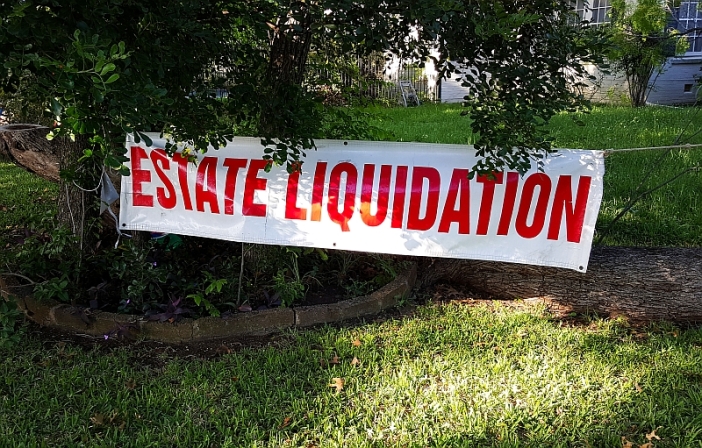
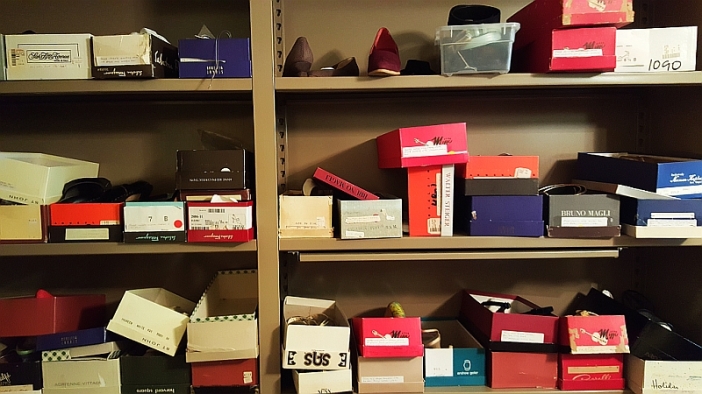
I have to admit that this sort of shopping beats the hell out of a visit to IKEA or some such place.  I am particularly fond of estate sales even though I always feel a little sinful—that might not be exactly the right word, but it’s close—while picking up and handling a family’s once-cherished possessions.  Poking my nose into their bedrooms, bathrooms, living rooms, dining room, kitchens, and private crawl spaces invariably leaves me feeling a bit like an impertinent ogler.  For example, if I walk into a home where the owner had an obsession for footwear—there are plenty of houses that are simply stuffed to the rafters with an obscenely large number of pairs of women’s shoes—I always feel like I’ve discovered a family secret that the inhabitants would have preferred not to have become common knowledge.

shoes

Estate sale shopping is always a little sad, too.  I invariably run across wheelchairs, walkers, and packets of unopened adult diapers, the tell-tale signs of deterioration and demise.  I often find that my eyes fixate on these items as my mind tries to conjure an image of the person (or persons) who used them.  I then turn away and wander into a new room, one where the walls are decorated by dusty black-and-white photos of people I’ll never know and who are probably long gone and forgotten.

Not long ago, while the two of us were walking down the hallway of a particularly large house that was simply bursting at the seams with stuff, Azza stopped me dead in my tracks by grabbing my arm.  “Troy, promise me one thing,” she said with a troubled look on her face.

“What’s that?” I asked her.

“When we die, you’ll never let anyone open up our house in this way.”

“OK,” I said.

She then let my arm go and we continued moving from room to room, picking up a few purchases as we went along.

I’m Pretty Sure I’ve Been Here Before

Life takes some incredible twists and turns.  About a million years ago, I was born in San Antonio, Texas, a city that’s a little bit America and a little bit Mexico, and then, back when I was still pooping in diapers, mom and dad carried me off to Garland, a suburb of Dallas.  Over the decades, I have had one or two opportunities to return to my birthplace, but only as a tourist and only for very brief visits.  Mostly, I’ve been estranged from the locale that could rightfully be called my hometown.

Then, in the latter days of September of 2015, a few months after I’d left my post at The American University in Cairo, a very sudden job offer in San Antonio came my way while Azza—my Egyptian wife of five years and new America émigré—and I were camped out with family, in their guest bedroom, in another part of the Lone Star State.  Of course, I signed on the dotted line, right where my new employer told me to.  We then loaded up, headed to south Texas, down where the beautiful language of Spanish is ubiquitously spoken, and set up house.

All these years later, I am back in San Antonio, the place where I (literally) got my start.  From time to time, when I’m tooling around the city, I get this weird déjà vu feeling.  As a matter of fact, this past weekend, Azza and I went to the San Antonio zoo, and while standing in front of the flamingo cage, I had this odd sensation that I had stood in this exact spot before.  The bird scene before me seemed bizarrely familiar.  I lifted my camera, took a few photos of the pink, hook-nosed birds, while goosebumps rose on my arms.

flamingo

We spent three hours among the animals and enjoyed our time more than I can accurately articulate here.  I’ve always been a nut for creatures—this nuttiness was especially acute when I was a tyke—and I felt that old delight resurface as we moved from cage to cage.  For some reason, on this particular outing, I especially liked the fish in their various watery enclosures.  They swam past us, flashing a zillion neon colors as they went.  In fact, I was so captivated by them it took me a while to actually notice that in one particularly large aquarium there were two hippos, their grotesquely large bodies magnified by the water, floating among those finned and gilled darters.

I’ve included a few photos here and am upset with myself that I didn’t get a good shot of the gibbons as they swung through the treetops, picked insects off on another, and otherwise reminded me of how humanlike they are.  While watching them do their monkey business, I got so enthralled—my mouth was probably agape—that I simply forgot to lift my camera and click the shutter.


I’m the Boss (and So Is Bernie)

I want to start by saying something that should be obvious to everyone:  I’m the boss of this blog.

Oddly enough, even though I’m the owner and CEO of Thinker Boy, Inc., it wasn’t entirely obvious to me, though.  My most recent posts, all of them personal reflections on my profession—I’m a teacher—had started to feel stale and I was growing bored while writing them.  Still, I hadn’t turned away from the topic because I had promised to complete the project.  Guess what?  I’m going back on my word.  I’m discontinuing the series of blogs I’d been calling “The Accidental Teacher.”

I blog a lot like I travel.  When I go somewhere as a tourist, I never make a plan before arriving at my destination, nor do I carry a guidebook.  I like to arrive in a state of naiveté, which assures that I’m going to be surprised as I roam around.  When traveling like this, I wander upon an interesting spot, one I’d never expected to find in the first place, and stop to look for a while.  When the time feels right, I turn my back and walk away.

I’m using this analogy to tell you that I’ve been looking at the topics of “education” and “my life as an educator” long enough.  I’m now ready to stroll away from them and make new discoveries.  I guess I could be a more focused writer if I were a more focused person.  Part of the reason I’m unfocused is that I have so many interests.  I’m all over the place and so is my blog.

One of my interests is American politics.  Lately, I’ve been obsessed with the competition between Bernie Sanders and Hillary Clinton.  (FYI:  The Republicans only interest me to the extent that their current crop of candidates are capable of disturbing my sleep by giving me nightmares.  One of them in particular—I think you know which one I’m talking about—seems hellbent on causing the whole sane world to have really bad dreams.)

I’m a Sanders guy and I FEEL THE BERN every day of my life.  If you want to follow my thoughts on the contest, go to my Twitter page and have a look.

My Egyptian wife and I live in San Antonio, Texas, and we are very active people.  While moving around and through Texas’ second largest city, we see many streets with houses that have Bernie Sanders signs in their front yards.  To date, I have not seen a single Hillary Clinton sign even though she won the Texas primary a while back.  Who are these Clinton supporters and where are they?  They sure seem like a shy bunch, at least in these parts.

In an attempt to get to the bottom of what motivates HRC supporters, Camille Paglia has written an interesting piece with a very provocative title—“Enough with the Hillary Cult:  Her admirers Ignore Reality, Dream of Worshiping a Queen.”  I wholeheartedly recommend that you read it.

Sanders is constantly calling for a revolution in America.  By this, he means we need to revolutionize our thinking.  Sanders, of course, would never ask others to do something that he hasn’t already done himself.  If you want to see what he means by this sort of thinking, watch the video below—it’s the speech he gave at the Vatican—and you will certainly see a politician who has embraced the sort of progressive ideas that many would find revolutionary.

When was the last time you heard a candidate for president talk about the weak and downtrodden and argue that America’s profits-before-people economic system is “immoral” and even “unsustainable?”  If you can’t hear the voice of saint—or a jewel of a politician—when Sanders speaks, you need to get your ears checked.  You might want to check your ticker too—to make sure you haven’t become heartless.

We in the 99% are those who Sanders is looking out for and talked about in Rome.  By running for president, he’s throwing us a lifeline and we need to be smart enough to grab it.  If we don’t, we may find ourselves sinking to the bottom of the deep, blue sea.


The Accidental Teacher: An Essay and Memoir (Part 9)

I have had a pretty unique job during most of my adult life.  I have been a teacher—for what seems like forever now—but I’ve never really been the sort who wanted my students to become more knowledgeable, which I associate with acquiring information.  Instead, I have tried to help them hone skills that promote wisdom or shrewdness.  In other words, I haven’t focused on what they should know but on how they should know.  “How” one knows is often referred to as thinking.

Most people believe that thinking comes naturally to everyone because we’re all born with brains.  It’s true we’re born with this organ, but there is a world of difference between run-of-the-mill thinking and critical thinking (or good thinking), just as there is a world of difference between the sounds made when my untrained fingers hit the keys of a piano and the music produced by a world-class concert pianist when his or her fingers touch the ivory.

There are a million things which interfere with good thinking.  At the moment, I don’t have time to get into all these factors.  The old saying, “The apple doesn’t fall far from the tree,” explains one of the most important influences on our intellectual development.  Most grow up thinking in the same way their parents did and thus believing in the same things too.  Our parents are our first models and their influence leaves a deep imprint.  To be able to “fall far from the tree” requires that we have to, at some point, question our parents’ way of seeing the world and this takes great courage.  In fact, there is no activity in life that requires more bravery than to think critically because to do so one must sometimes say “no” when important others (or maybe even the whole community or world) is saying “yes.”  Saying no when others are saying yes can be costly or even dangerous.  It’s certainly easier (and more comfortable) to just go with the flow.

I’m thinking a lot about thinking these days because that’s what I do.  Plus, it is campaign season in America and that means the news is full of stories about powerful and ambitious people putting their thinking on display in an attempt to get others to vote for them.  In the interest of full disclosure, I’ll just go ahead and tell you that politicians with the most progressive points of view generally tend to think a lot better—I’m not talking about their ideas, which I also find attractive, but about the methods they use to formulate their ideas and then state them to the public—than do conservatives.  Political conservatives—I actually like to call them “regressives”—make a lot of very classical thinking mistakes that many others might not catch because they aren’t trained to look for them the way I am.  In fact, regressive politicians often make arguments that simply leave me shaking my head.  The fact that so many Americans find such unskilled thinking attractive often makes me despair about the future of the country.

At this point I should probably tell you that I made myself a promise several years ago.  I promised to do whatever was necessary to become the best thinker I could possibly become even if this meant that I would ultimately have to embrace very unpopular ideas.  In my attempt to constantly improve myself intellectually, I often find myself butting heads with what is called “conventional wisdom,” which is mostly a first-rate oxymoron.

I want to conclude by reiterating something I said in a previous blog.  Critical thinking is a way of being.  It is a method of living life with great integrity.  It is not something I turn on and off at will.  It has become the way I conduct myself in this world.