And Nothing But the Truth

20180108_081613

I received an odd piece of mail during the recent holiday period.  The return address showed that the sender was a “CHIEF CENTRAL JURY BAILIFF,” not the sort of personage I regularly keep in touch with nor the type of individual I expect a Christmas card from.  The all caps were a touch intimidating.  I began to relax as soon as I read the words “JURY SUMMONS” printed on the exterior of the envelope.  Still, I wondered, what’s with all the shouting?

To make a long story short, I was being asked to do my civic duty and show up at the Bexar County Justice Center, an imposing building located right in the heart of the city of San Antonio, Texas, at 8 a.m. on January 8th.  The Honorable Catherine Torres-Stahl, presiding judge of the 175th District Court, was requesting my presence at the place and time indicated.  When I flipped the summons over, just to see if there were some loopholes that might allow a pretty accomplished shirker a way out of appearing, I was informed, in quite clear terms, that failure to comply would allow the authorities to fine me “not less than $100 nor more than $1,000.”  Pronouncements of this sort are generally pretty effective in turning most of us into model citizens.

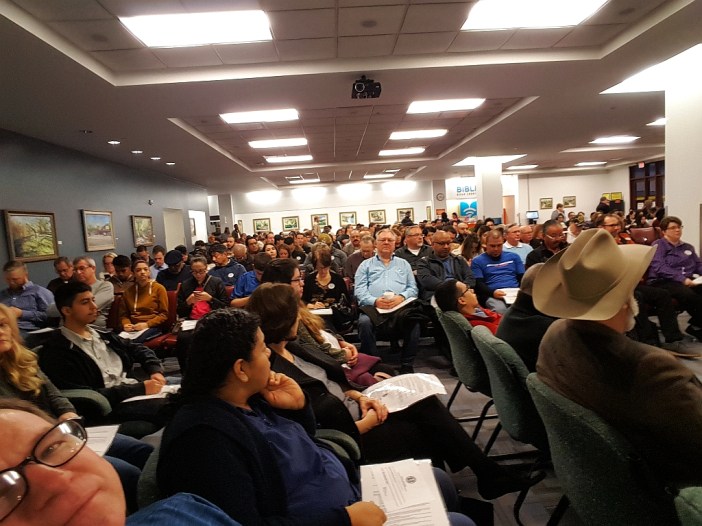
So I arrived early in the morning at an hour when many folks were still working on filling their daily quota of yawns.  They told us to go to the basement, which I did, where I found hordes of people being lined up and herded into a large room that resembled a holding pen.  The people kept coming and coming until all the chairs were filled and then the overflow were asked to stand in the aisles.  At one point we were informed that the room held no fewer than six hundred human beings.  Because I was astounded by the number of folks assembled, I took out my mobile phone and inconspicuously took a photo of a fraction of the throng only to be told, minutes later, that no sort of photography, other than selfies, would be allowed.  Of course, the absolute worst place to do the forbidden is anyplace where there are people with guns who’ve been given the authority to use them.

Eventually, my name was called with sixty-seven others.  They sent us to the third floor this time.  We huffed and puffed our way up flights of stairs where we were met with a bailiff with a gun on his hip.  Each one of us was assigned a number—mine was forty-eight.  He then lined us up in order and said, “Whenever we go into the courtroom—it could be five minutes or it could be much longer than that because, you know, there are lawyers involved.  Anyway, once we are called, we will enter in exactly the same order we are in now.  If you go in out of order, it means I haven’t done my job well.  I don’t like it when people think that I’m not good at what I do.  I know I sound mean, but I’m a man who has been married for twenty-five years.  That’s long enough to give any fellow a mean streak a mile or so wide.”  (Several people laughed at that, and it was clear he knew how to work an audience.)  Once the laughter had died down, he ran his fingers through his hair and said, “True story.  When I was a young man and just newly married, I was a sweetheart, but my wife, well, she’s something else and she has had her influence.  I won’t say she scares me, but do you see this gun, I sleep with it under my pillow at night.”  Again, there was some laughter but a little less this time.  Once it was over, he said, “Folks, I’m just kidding.  I don’t want to give anyone the wrong impression.”

The bailiff then disappeared and I began to wonder if he might moonlight at one of the standup comedy shops in the city.  I didn’t have long to ponder that possibility because we were soon called into the courtroom.  As luck would have it, I got a front-row seat, which allowed me to have an up-close-and-personal view of everything, including the judge at the rear of the room, the district attorneys (two youngish women dressed smartly in suits) and the defendant and her lawyer, a bald African-America who wore a wry smile through most of the proceedings, especially when he stood up and began to address the potential jurors.

The vast majority of my experience that day was humorous, in a sarcastic and tongue-in-cheek sort of way, except for when the judge read out the charges against the defendant:  Several counts of aggravated sexual assault of a child.  While the judge was saying all this, I watched the accused carefully.  She immediately turned her face away from us and toward the floor.  Tears began to well in her eyes and then flow down her cheeks.  At one point, I noticed she began to shake uncontrollably.  Possibly she found the courtroom to be a cold place, but I don’t think her shivering had anything to do with the temperature in the room.

It finally came time for the lawyers to ask us questions.  I was especially interested in the defense attorney.  While speaking, he paced some and was often standing no more than four or five feet away from me.  An interesting line of thought occurred as I watched him.  We Americans have a very romanticized view of lawyers and courtrooms.  This idea comes from Hollywood, but real lawyering—the kind I saw happening in front of me—looked a lot more mundane, like teaching, which I happen to do but for much smaller paychecks.  I could see that the attorney was running through his well-rehearsed list of queries and that he was sort of on autopilot.  There was no drama, nothing riveting.  Then, once those legal eagles had questioned most of us, we were made to go sit in the hallway where, once again, our bailiff tried out some of his best comedic lines.

My day ended not with a bang but with a whimper.  I was told that I wasn’t going to be seated as a juror.  In a way, this sort of bummed me out because I wanted to see how it would all end up.  I wanted to see if the defendant—a perfectly ordinarily looking individual who could have been a friend or relative—would walk free or spend a large portion of the rest of her life doing something a lot more confining.

 

LOOK

laptop-eyes-technology-computer


I wrote this a little more than a year ago, but it seems, once again, very apropos…

***

I can’t believe I’m being dragged back into politics.  But that is exactly what’s happening.

In 2015 I quit visiting all the political websites that had held my interest for many years.  I stopped thinking about politics and discussing the topic with others.

2015 is also the year I left Egypt after living and working there for seven years.  During that time, I was very political, at least from 2008 to 2014.  In 2011, I witnessed the mass uprising against Hosni Mubarak and found myself swept away by the euphoria that followed his deposing.  Then, two years later, during the month of July, I watched in horror as Egypt’s first democratically elected president, Mohamed Morsi, was overthrown in a military coup.  Some very scary characters referred to it as a “second revolution,” but the more apt term was “counterrevolution.”

The counterrevolution crushed my spirit but not because I was a Morsi fan.  I was devastated because I had seen how hard brave Egyptians had fought to free themselves.  And I saw the sacrifices they’d made.  Suddenly, though, they were right back at square one or even worse.  The only way I could survive such devastation was to numb myself.  So, I withdrew from politics and became apathetic, which takes me back to the point I was making about myself in the second paragraph.

I had a bit of a revival when Bernie Sanders decided to run for president.  The old political juices began to flow again.  From the moment he declared his candidacy, I felt the Bern.  Eventually, he built an incredible following and I began to see a glass that was half full.  Egypt had certainly lost its way but America, it seemed, was on the verge of finding its soul.

Then the Democratic Party machine decided that Hillary Clinton was somehow owed the nomination.  Bernie was treated unfairly and his supporters were pushed aside.  Many of us warned that Clinton was too compromised and therefore vulnerable.  Too few listened to those warnings.  Too many people were too certain about what they thought was a foregone conclusion.  There were many ominous signs for those with the ability to see and read them.  With Bernie out of the race and everyone saying Clinton was a shoo-in, I began to lose interest again.

But I never drifted entirely away.  That weird sense of foreboding I felt wouldn’t let me turn completely off.  The mood of the nation reinforced the sense of dread I felt.  It seemed all too possible that something catastrophic might happen.  And it did on November 8, 2016, a date that go down in infamy.

Now that the world as we’ve known it is in the process of vanishing, the old jump-up-on-a-soapbox Troy has reawakened.

I grew up during a period when Americans smugly believed that the nation and its people were somehow special—or exceptional.  They watched as other countries fell apart or came under the influence of evil powers but felt that such things could never happen in the greatest country the world had ever seen.  America would always remain the beacon.  It would always set the model for others to follow.

But just look where we find ourselves now.  Just look.  Look long and hard.  And while doing so, make sure not to turn your eyes away.  Don’t delude yourself into believing that what you see isn’t as bad as many are suggesting.

The truth is, it’s every bit as bad as people are saying.  We cannot know for sure how bad it may get, but it is already way beyond horrific.


A Tart to the Heart

Azza
Azza

Often, when people find out that I’m married to a woman from Egypt, they ask me, “So, how did you two meet?”  The following is the story of how I came to know my lovely and talented wife.

***

I’ll never forget the first time I laid eyes on Azza.  It happened on a hot April day in Cairo in 2011.  Only months earlier, in January to be precise, the famed Egyptian Revolution, the upheaval which would result in the overthrow of Hosni Mubarak, Egypt’s long-time dictator, had kicked off and the nation was still jittery and recovering from those cataclysmic events.  Anyway, on that fateful April day I happened to have a day off—I’d come to Cairo in August of 2008 to teach at the American University in Cairo—and was working out at the gym at the Community Services Association, a hangout for expats and English-speaking Cairenes.  I finished up, toweled the sweat off my body, and left.  On my way out of the compound that housed the gym, coffee shop, café, and other CSA facilities, I passed by a group of tables where several women were selling international dishes.  Behind them, on the wall they’d positioned themselves in front of, was a big placard that read “Cook’s Day Off.”

I was intrigued so I stopped to have a look.  The first woman I happened to notice was someone who looked to be from the Indian Subcontinent.  She spoke up and said, “Would you like to buy my Indian food?”

“Maybe.  What is all this?” I asked, waving my hand to refer to the spread of food on the tables in front of me.

“We’re with Cook’s Day Off.  We sell international food here at CSA twice a week.  These are small-sized portions for you to eat when you get home this evening or you can stock your freezer with them.”

“I see,” I said, and then I noticed that there was an Asian woman selling food from Thailand and someone—she didn’t look Italian—hawking perfectly packaged smallish portions of various raviolis and lasagnas as well as tiramisu and some other things I was not able to immediately identify without reading the attached labels.

I began to pace back and forth in front of the tables and look down at all the varieties of food.  Suddenly, the woman selling Italian spoke up and asked, “Do you like ravioli?”

“I do,” I said, and then, for the very first time, I looked directly into her eyes.

“Are you Italian?” I asked, thinking, all the while, that she was stunningly attractive.

“No.  I’m Egyptian.”

“But you cook and sell Italian?”

“Yes, because I was trained by an Italian chef and partnered with her in the past.”

“I see.”

In the end, being the bachelor that I was and perfectly helpless in the kitchen, I bought a little bit of everything, including two packages of spinach ravioli and two Italian tarts that featured chocolate.

On the way home, I couldn’t get the Egyptian woman out of my mind.  I started thinking about how wonderful it would be to go out with her on a date, but how would I ever get to know her name or find a way to make contact with her?

I was on foot, and I suddenly stopped on the crowded sidewalk.  People began to jostle into me but I took no notice of them.  I reached into the Italian bag and retrieved one of the tarts as I remembered that each package bore a label.  I took off my glasses and brought the tart up close to my face so that I could read the fine print right below the production date and list of ingredients.  Right there, in black and white, were the words “Azza Omar” and a telephone number.  That discovery prompted a huge smile to turn up the corners of my mouth.

I put the tart away and rushed home.  As soon as I got inside my apartment, I popped the plastic cover off the tart and cut a slice which I immediately crammed it into my mouth.  A plan was forming while I chewed.  Immediately upon swallowing, I took out my mobile phone and looked at the label again.  I then composed the following text:  “Hi.  My name is Troy.  I just bought two of your chocolate tarts.  As soon as I got home, I tried one and it was great.  Thank you.”  I clicked send as soon as I’d checked it for grammar and spelling errors.  I then began to pace back and forth in my kitchen.  In about two minutes, she responded, “You are welcome.”

***

Three weeks to the day after buying tarts from Azza and then texting her, I was sitting in front of my computer in my office on the campus of AUC.  My phone was sitting next to me and it rang.  When I looked down and didn’t immediately recognize the number, I let it ring until the caller eventually hung up.  I had a class to teach in about an hour and was busy prepping for it, so it was easy to ignore the call I’d just gotten.  A few minutes later, my phone rang again.  It was the same number belonging to the same unknown person.  I sighed and then decided to answer it.  “Hello,” I said.

“Hi.  May I speak with Troy?”

“This is Troy.  Who am I speaking with?”

“Azza.  You bought some of my Italian food two or three weeks ago.”

“Oh, hi, how are you?”

“I’m fine.  And you?”

“I’m good, thanks.  I’m sorry but I’m at my work today and won’t be able to come to CSA to buy any of your goodies, but I promise that I’ll come soon and get some more.”

“Actually, I’m not calling about my food.  I just wanted to say hello and to see how you’re doing.”

“Really?  You’re calling to say hello?”

“You seemed like a nice person when we met, so I thought I would see how you’re doing.”

“You seemed nice too.  Hey, would you like to meet in Maadi sometime for coffee or a Coke or something?”

“I’d really like that,” she said.

“I’d like it too.  How about this coming Thursday at six or seven in the evening?  Would that be a good day and time for you?”

“That would be great.  As it just so happens, I’ll be in your neighborhood at exactly that time to deliver an order to a customer.  I also cater and do a lot of parties, especially for Italians.”

“That sounds interesting.”

“It is.  Anyway, Thursday evening is fine.”

“Great!  Let’s meet at CSA then.”

“CSA is perfect.”

***

So, that’s how things got started between the two of us.  The rest, as they say, is history…


Azza, Christmas Cooking, and the Great Aunt Jemima

From 2008 to 2015, I lived in Cairo, Egypt, and taught at The American University in Cairo.  In the spring of 2011, about midway through my seven-year stint in North Africa and only two months after Hosni Mubarak was pushed out of office by an enormous uprising of fed-up Egyptians, I met Azza, a born and bred Cairene and the woman who would become my wife less than a year later.

When I met Azza, she had a successful catering business, specializing in Italian food.  Now that we are living in the US—in interesting San Antonio, Texas, a place that feels a little like an American city with a whole lot of Mexico mixed in—my wife is once again considering starting her own enterprise.  This time, though, she’s looking at opening a home bakery.  (The Lone Star State doesn’t heavily regulate the cottage food industry, thus incentivizing those who wish run such a business out of their own kitchens.)

We just finished up with the Christmas holidays.  By the way, my wife is a Muslim and she just loves this time of year.  In fact, she single-handedly destroys all the ugly stereotypes that many close-minded people—I’m thinking mostly about the Trump Evangelicals as I write this—have about practitioners of Islam.  I bring all this up because she did a ton of baking in the run-up to the twenty-fifth of December, and as is usually the case, because she is such a professional in the kitchen, she wrapped a turban around her head to keep stray hair out of the food she was preparing.

One morning I saw her with such a wrap on her head and told her she looked like Aunt Jemima.  Knowing that wouldn’t understand such a reference, I tried to explain who this person was.  As luck would have it, I went to the grocery store a few minutes later and found the appropriate aisle—the one where they kept the syrups for pancakes and waffles and such—and took a picture of the label with America’s beloved Aunt’s photo on it, only to discover (and quite surprisingly too) that the Jemima of today bears little resemblance to the Jemima of old.

The conspiracy theorist in me immediately jumped to the conclusion that they took her turban off because it looked too much like a hijab.  I figured that Quaker Oats didn’t want to feature a character who looked too foreign or too exotic or too Islamic.  After all, this is Trump’s America and the rest of us are only living in it.

As it turns out, there was a reason for the company to modernize Aunt Jemima’s image, but it had nothing to do with them trying to make her look less like a Muslim.  I’ve included a video that explains the whole interesting story about the politics behind the revamping of the image of this cultural icon.


Rich & Cheerful

christmas ale

I drank my first beer when I was fifteen years old.  It happened at a party during the summer break between my freshman and sophomore years in high school.  Someone—a complete stranger, in fact—handed me a bottle of Miller High Life and I pulled the ring tab.  I then took a sip and grimaced.

I didn’t have an immediate appreciation of “The Champagne of Beers.”  In fact, as soon as I drained the can, I politely excused myself from that social gathering, went outside, and found a remote spot where no one would see or hear me vomit.

Since that first beer experience, I’ve finished at least a million bottles and cans and have gone through several phases as a drinker.  Luckily, I survived the “Self-destructive” period with body and mind mostly intact.

Today, I am in my “Beer Appreciation” stage.  I now have the money to buy bottles put out by international and/or obscure breweries.  When I open such a beer, especially one I’ve never had before, I like to get all my senses involved.  I like to pour the liquid into a glass so that I can see its color and translucency.  I then often swirl the liquid, to see how it behaves, and breathe in its aroma before taking my first sip.

Lately, my favorite beer is called Wild Blue and is put out by Blue Dawg Brewing.  I never would have imagined that I’d like a lager that has a blueberry base, but I was pleasantly surprised.  The fact that each bottle contains eight percent alcohol by volume doesn’t hurt.

In four days it will be Christmas, so lately I’ve been drinking special Christmas brews.  Today, while writing this, I’m drinking Ye Old Christmas Ale, produced by Saint Arnold of Houston, Texas.  The bottle says that the beer is “Rich & Cheerful.”  I think they mean that the consumer, after putting away a couple of bottles, has a rich and cheerful feeling in both his head and heart.


M****** Wanted to Ride Me Like a Donkey

A few days ago I started penning  a memoir as a way of coming out of a period of creative dormancy.

This post–the part that follows this intro–is an excerpt from that not-yet-titled autobiographical work.

This will be my second autobiography.  The first one was called Blue Yonder.  It was never published even though I sent it off to several literary agents in NYC (and elsewhere) and was able to generate considerable interest.  M****** K******–I don’t remember the name of the agency she worked for–strung me along for months.  She liked the manuscript but requested a few rewrites which I completed.  She also asked me to write up a book proposal.  Again, I obliged.

I sent the proposal off and she took a long while reviewing it.  She came back with a critique of my marketing plan.  She asked me to do a little research on how to market a work of nonfiction and then resubmit the proposal.  Being the good boy that I am, I did all that she asked.

To make a long story short, she eventually, after giving me the run around and building my hopes up, sent a cursory rejection note.  This had been the culmination of months of work on my part and lots of to and fro emailing.

This whole experience taught me lessons.  For one, my writing is good enough.  (She even told me so.)  Secondly, her sole reason for rejecting me was rooted in the fact I hadn’t proved to her that I could be a good salesman.  By the way, I never, not once, not even in the initial query letter, promised that I was an experienced hawker of books.  (Isn’t it asking enough that one be able to write one?)  Wasn’t she supposed to do something other than contact the publishing houses after I’d put years of labor into the project?  Her webpage promised that she would be with her authors every step of the way.  Did she really mean that or were those just pretty words?

What M****** wanted was to ride me like a donkey.  I was supposed to carry her to the place where all the money could be found and then she would jump off my back long enough to fill her saddlebags with dough.  Had I signed up with her and had book sales lagged, I sure she would have taken out a stick and flogged me on my butt along with digging her spurs into my flanks.

Anyway, I’m ready to try again, but not with M******.  The first couple of pages of the first-draft of this second attempt can be found below:

***

My heart is untroubled, and my face wears a permanent smile.  When I close my eyes and try to visualize what I look like, in my current state, I see myself as a contented Buddha-like character, sitting with crossed legs under a lotus tree.

I’m speaking metaphorically, of course, as well as beating around the bush.  I’m trying to say that I’m in one of those rare good places in my life where everything seems to have worked out perfectly well and now, as a result, I am truly happy.  I don’t know if this wonderful turn of events happened because I was able to engineer it to be so or if it’s the result of pure dumb luck.

Most of the last two years—up until about four months ago—have been damned hard, and I was, during that period of darkness, not at all feeling blissful.  Looking back at my recent past, I could say—without being guilty of anything that even remotely resembles exaggeration—that I’ve just come through hell.  On my trip through the fiery pit, I got a bit singed but wasn’t wholly reduced to ashes.

My story starts on the evening of July 2, 2015, the day I landed at Austin-Bergstrom International Airport in Austin, Texas, and was greeted by my father and stepmother.  I hardly remember my arrival in Texas’ capital because I was so exhausted.  I’m sure that the three of us talked about how my flights had gone and other inane subjects while we waited for my two pieces of luggage to find their way onto the baggage carousel conveyor belt and then into my hands.  We then made our way to my parents’ parked car, loaded my suitcases into its trunk, and drove the whole kit and caboodle to Georgetown, Texas, a beautiful, smallish city that’s located just up Interstate 35 about half an hour or so.  Once in Georgetown and at my folks’ place, I went immediately to bed and slept the fitful sort of semi-slumber I always have after completing one of my international sojourns.

This particular trip had been a really long one.  I’d started it in Cairo, Egypt, and had passed over portions of three continents—Africa, Europe, and North America—and two significant bodies of water—the Mediterranean Sea and the Atlantic Ocean.  I’d had a long layover at Paris’ Charles de Gaulle International Airport where I wiled away the hours awaiting my next flight by wandering among souvenir shops and looking at tiny, plastic versions of the Eiffel Tower.  My movements through said shops bore a strong resemblance to the way a zombie might wander in a post-apocalyptic landscape.  On a side note, many people who travel by plane have the good fortune of being able to sleep aboard those big birds as they cruise high above terra firma, but I am not blessed like this, which means that I always have to find ways to kill time.  Often, while on board, I achieve this by drinking as much alcohol as my belly and bladder can hold.  This method is tried and true for me and I took full advantage of it as I made my slow way over land and sea…


An Amazing Accomplishment

I’m republishing this.  It originally appeared in Savvy Women’s Magazine, in the humor sectiona few years ago.

***

My mother (bless her big ole Southern heart) should be presented with a medal in a public ceremony.  I’m thinking it should be made of gold and look like the ones they give away at the Olympics.  Once she bends over and it’s slipped over her head, the crowd should jump to its collective feet and give her a standing ovation.  The presenter might then give a short speech in which she lauds my mother and concludes by explaining that the following sentence has been engraved on the medal:  “She put up with Troy Headrick all these years.”

There are plenty of people who couldn’t have done what my mother did.  (I’ve got two ex-wives to prove it.)  Not only has she put up with me, she’s done it with aplomb and a sense of humor.

I suppose I was a difficult child from very early on.  It wasn’t that I was one of those cranky babies, the kind that spend a lot of their time crying themselves sick.  In fact, most people who knew me at that time in my life say I was a sweet-natured child.  Nor did I fight with other children or torture animals or pee the bed thus requiring the use of plastic sheets.  I wasn’t a gross child either, the sort that eats boogers when no one is looking.

I was difficult because I was different.  If it’s possible for a child to be eccentric, then I was an eccentric child.  As one might easily imagine, the older I got, the more unusual I became.  Now, as an adult, many would claim that I have achieved the status of a full-fledged weirdo.

In recent years, my eccentricity has most visibly manifested itself in the lifestyle I’ve chosen to live.  For most of the last fourteen years, I’ve been living overseas–in strange places too, like Poland, the United Arab Emirates, Turkey, and now Egypt.  For a lot of people, I suppose, leaving America and taking up residence in places like these wouldn’t be so unusual, but I come from an old-fashioned southern family where people just don’t do such things.  My kinfolks stay put.  As a matter of fact, most of those in my clan, young and old alike, reside not far from where they were born, in little towns where they don’t even wait until sundown before they roll up the sidewalks.  Such folks live simple, predictable lives.  For them, a real splurge is going out to Dairy Queen for a chocolate sundae in the middle of the week.

It goes without saying that a person can’t live the way I have done in recent years without also acquiring some pretty unorthodox views on a number of subjects.  For example, I’m pretty critical of television and TV viewing.  As a matter of fact, I haven’t owned a boob tube since July the twelfth of 2002.  When I tell people this, their foreheads often sort of wrinkle up and then their eyelids flutter for a second or so.  These are the unmistakable signs of incredulity.  But why shouldn’t people be incredulous when they hear me say this?  There are probably only six or seven people in the whole wide world who can make this same outlandish claim.

I’ll never forget that hot day in July, all those years ago now, when I sold my 24-inch Sony, the last television I ever owned, in an apartment sale to a friend named Stephanie just before I left Abu Dhabi, capital of the UAE.  Only moments before Stephanie handed me the two twenties and a ten, I got cold feet.

“Are you sure you want to buy this thing?” I asked her while trying to hand the money back.

“Why?  Have you decided to keep it?”

“No, I want to get rid of it, but maybe not to you.”

“So you want to give someone else, other than me, your very best friend, the chance to make a really good deal?”

“You’re right.  Enjoy your new television,” I said as I pocketed the money and then smiled weakly.

As the two of us loaded the thing into a taxi, I felt really troubled.  If I truly believed that watching TV was harmful, then how could I, in good conscience, unload one of the accursed contraptions on Stephanie?  Doing so made me feel like a drug dealer, a pusher.

About a year ago, on one of my visits back home to America, my mother and I happened to have a conversation about television one night.  This gave me the opportunity to share my radical views.  As I talked about all the ills caused by watching TV, I found myself getting all worked up.  At one point, I jumped out of my seat, stomped around the room, turned red in the face, and tore at the hair on my head.  I went on and on about how TV was one of those factors contributing to the dumbing down of America.  I cited statistics about how few Americans read books.  I argued, with great passion, about how the idiot box was turning people into unthinking automatons, easy marks, in other words, for manipulative demagogues.  After I had said my piece, I fell back into my chair, exhausted but confident that I had spoken with power and conviction and insight.  I’ll never forget how my mother sat there, listening to my ravings with this Buddhist-serene smile on her face.

“You may very well be right about some of the things you say,” my mother began after I’d cooled off some, “but I, and others like me, like to watch TV.  We do so because we think watching is fun.  It adds something to our lives.  It may also take something away.  That’s true.  But most people think the trade-off is worth it.”

Because I was still breathing heavily, I was in no condition to offer a rebuttal, so I simply sat there and let her words sink in.

“Now, if you’ll excuse me, Big Brother is about to come on.  This evening someone will get voted out of the house.  Why don’t you stay and watch a few minutes with me?” my mother asked.

When I didn’t immediately reply, she added, “At any point along the way, if you feel your brain getting all squishy, like it might be melting down, you can certainly leave the room in a hurry.”

“Well, I suppose five minutes won’t kill me.”

“Probably not,” my mother said, and then she hit the power button on her remote.

© Troy Headrick, 2008

Originally published in Savvy Women’s Magazine

http://www.savvy-women-magazine.com/Humor/my-eccentricity.php


Why Granny Smoked

I was on the internet the other day and found this old personal essay I’d published several years ago in Savvy Women’s Magazine, a publication I used to write regularly for.  I think the piece still holds up relatively well, so I’ve decided to republish it here. So, for your reading pleasure, I present “Why Granny Smoked.”

***

I’m sitting here thinking about my great-grandmother, my “Granny,” a woman who was born in the nineteenth century and died in the twentieth, at the age of ninety-two, mostly from terminal orneriness.

I’ve got a good, clear picture of her in my mind. She had sunken eyes and great moles on her face. She wore cat-eye glasses and dipped snuff until she traded that bad habit in for another—lighting up. She smoked her first Marlboro when she was in her 80s.

I used to go see her once a month or so whenever we had family get-togethers. We would pile into our car, drive down our gravel road, and putter to town, which happened to be sleepy Georgetown, Texas, where she lived in a little house on Maple Street with her husband, my “Granddad,” a bear of a man who tottered around the place and never said a word to anyone that I ever heard. Their four children—Etta Merle, Sherman, Mavis, and Estelle—also lived in Georgetown or in towns not far away. By the way, Etta Merle, the eldest, is my maternal grandmother, a woman who, to this day, I refer to as my “Memaw.”

I have noticed that whenever anyone in the family reminisces about Granny, the first thing they’re apt to mention is the greenness of her thumb. She took that special ability with leafy things and used it to turn the space around her house into a tiny version of the Amazon rainforest.

Because of the surrounding jungle, it was very hard to see my great-grandparent’s house when we drove up and parked on the street in front of it on one of our visits. We knew it was back there, somewhere, among the vines and things, if for no other reason than part of its roof was visible from our vantage point, looming up above all that foliage. Walking down their front sidewalk was like a trip through the heart of darkness. A machete would have come in handy as we made our way to the front door. I always expected some exotic creature, like a capybara or a tapir, to dart out of the undergrowth and run across the sidewalk in front of us. All these years later, I can still hear my mom say, “Granny ought to have someone come in here and thin all this out some,” as we walked along.

“But they like it this way,” my dad would remind her. “At least she does.”

“I know it.”

“It reminds me of a Tarzan movie,” I added.

“I hope there are no headhunters…or cannibals,” my father said, and then he chuckled.

***
In 1970, when Granddad died of what some among us colloquially referred to as “hardening of the arteries,” the family decided that it was in Granny’s best interest to have her move in with her children. She spent a lot of time living with her eldest daughter, and because I spent so much of my young life at my Memaw and Pawpaw’s house, I got to know Granny a lot better in her last few years.

My grandparents put her up in a bedroom toward the rear of their little country cottage. Two decades earlier it had been my uncle’s room and hadn’t been slept in much after he graduated from high school and went off into the wide world to find his own unique place. To help Granny feel more at home, they’d rearranged the furniture and brought in a slew of potted plants that she’d had in her own house.

One afternoon, after school let out, I was at my grandparent’s home, just sitting on their living room floor watching High Chaparral, an old cowboy program that must have been filmed in Arizona or southern California. My Memaw was behind me, on her olive-green couch. She had her knitting glasses on and was going to town with her needles on a sweater she was making for my grandfather, an honest-to-goodness cowboy. She abruptly put everything down and said, “Do you smell smoke?”

I sniffed and then nodded my head.

The two of us got up and followed our noses to where they led us, which was toward the rear of the house. Granny’s door was cracked just enough for us to peek in, which we did. By covering one eyeball with my hand and then pressing the other one up to that slit, I could see her, sitting in a corner of the room, surrounded by plants, their outstretched tendrils nearly blocking her from view. Though she was partially hidden by that greenery, I spotted enough of her to notice something strange and unprecedented–a lit cigarette dangling from her lips.

“Mother!” Memaw said as she pushed the door open. “What are you doing?”

“Sitting here. What does it look like I’m doing?”

“I can see that. You know that’s not what I’m asking about.”

“What are you asking about, then?”

“About…about…that thing sticking out of your mouth!”

“Oh, you mean the cigarette?”

“That’s right…that CIGARETTE.”

“OK, so I’m smoking,” she answered matter-of-factly.

“I can see that, but why? And where did you get that thing?”

“Why not? Please use the right word, daughter. It’s called a cigarette, and I got it down at the store, along with two whole packs of them, which means I got forty cigarettes, or maybe only thirty-three or so now that I’ve had a few.”

“When were you at the store?”

“Yesterday.”

“I didn’t know you went down there.”

“I do a lot of things you don’t know about. I may be old, but I’m not dead yet. I can still get around pretty good.”

“OK, so you went down to the store yesterday all by yourself, but why are you smoking?”

Granny, with her teeth sitting in a jar not far away, looked at my Memaw defiantly without giving an answer.

My great-grandmother’s newly acquired habit of sitting in her room and puffing away became the subject of much conversation in the family. My dad speculated that Granny was tired of living and had decided to take up a habit she thought might speed things along, so to speak. Other people had different theories. Some of them made sense, others seemed, well, just strange. We all gave all these hypotheses lots of consideration.

One day I decided to find out for myself what the reason was. I tiptoed down the hallway and knocked on Granny’s door. “Yes, who is it? That’s not you, is it Etta?” she asked.

“No, it’s me,” I said.

“Come in then.”

I stepped into her room and saw that she was holding the stub of a burning cigarette between her fingers and that the air in the room was sort of hazy with blue smoke.

“Can I ask you something, Granny?”

“Sure, honey, what is it?”

“Why did you start smoking?”

Granny looked directly at me. Her eyes seemed to suddenly narrow and then tear up, but I doubted she was crying.

“Because it’s fun. That’s why. Plus, it’s something I’ve always wanted to do. At my age, a person doesn’t get many chances to do something brand new.”

“Do you like it?”

She thought for a second, took a drag, and then answered, “Very much.”

“But Memaw says that it stinks,” I informed her.

“Your Memaw has a funny nose.”

I thought about the implications of having a nose that was funny.

“Do you mind if I sit with you for a while?” I asked her a few seconds later.

“I don’t mind a bit, but you might get bored sitting with me. I’m nothing but an old bag of bones.”

“I won’t get bored.”

“Are you sure?”

I shook my head up and down very sincerely.

“Good. To tell you the truth, I feel like having a little company just this very minute.”

I kicked my shoes off and jumped up on her bed.

“Now, what else would you like to know?” Granny asked.

I thought for maybe a minute, and then I opened my mouth.

http://www.savvy-women-magazine.com/Humor/why-granny-smoked.php


#NotMyPresident #TheResistance

points-of-light

I have this friend named B*** S******.  We got to know each other while we were both teaching at The American University in Cairo.  I returned to the US in 2015 and he did so a year later.

When I came back, I got a pretty lucrative education and training job with the Department of Defense as a private contractor.  I was hired to work with foreign military personal—both enlisted and officers.  I had students from Saudi Arabia, Kuwait, Iraq, the United Arab Emirates, Oman, Djibouti, Jordan, Mauritania, Togo, the Democratic Republic of the Congo, Afghanistan, Georgia, Bulgaria, the Ukraine, Mongolia, South Korea, and Indonesia.  I might have left out a country or two, and I apologize if that’s the case.  Then, student enrollment declined, beginning in the springtime, and I got laid off exactly one year after hiring on, making me collateral damage which sounds a lot better than a bullet-riddled corpse that had been mutilated beyond all recognition.  It was the first layoff of my life and it came at the worst time imaginable.  In fact, it’s left me with ugly scars and something akin to PTSD.

B*** came back and got a job at a community college in some Podunk in the Midwest, an area sometimes called “flyover country,” and for good reason, because to land there puts one at risk of contracting a deadly form of ignorance, the sort that turns the brain to mush, making someone like Donald Trump look like a reasonable human being who might make a good president.

I might be giving my friend’s current place of abode away by saying it garnered national news a while back when the police arrested three scraggly, lily-white, neo-Nazi-looking guys who were in the midst of plotting to blow up a building inhabited by Somali refugees who had committed the heinous crime of leaving their troubled homeland to start life anew.  I’ll go back and look at the reports again, but I believe one Donald Trump, the fellow who froths at the mouth like a rabid skunk when you suggest he’s opened up Pandora’s Box of hate in the country, had been the rednecks’ primary inspiration.

To quote one of my favorite writers of the 20th century, a kinky headed dude named Kurt Vonnegut:  “And so it goes.”

B*** and I talk about politics on the phone from time to time.  During one of our pre-election conversations, I said, “There might be a silver lining to the election of DT if it happens.”

“What the hell would that be?” B*** asked incredulously.

“Well, in the short run, I agree it would be catastrophic, but in the longer term, it would likely be a powerful impetus to kick start a truly robust progressive movement the likes of which American has maybe never seen before.”

Do I see such a coming together of progressives happening now that we are living in the alternative universe known as Trump Reality?  Quick answer:  Hell yes.

The last time we talked—about two weeks after that very flawed presidential election—B*** was terrified.  (I could hear him quaking in his boots through the phone.)  His fear was that we were entering a phase where the fascist brutes, aligned with law enforcement, would just start rounding people up or mowing them down—whatever was most cost-effective and convenient.  I advised my buddy to get on Twitter and just have a look around at the pushback that was taking place against the Chief Nihilist of the US and his fascist minions.  If he did so, I exhorted him, he’d feel a lot better.

I have always felt that STEP ONE in the resistance of despotism can only come after millions of people have linked arms—this linking can start virtually, on places like Twitter—become comrades, and have declared a common goal.  This is happening as I write this.  If you’re feeling alone, hopeless, and isolated, reach out to others who are your political brothers and sisters.  Once you do this, you will begin to feel a part of something that is much bigger than yourself.  This will embolden and inspire you.  You’ll see that lots and lots of people have your back.

You will also discover resistance movements and find out about street protests and planned acts of resistance and civil disobedience.  Join one and become an activist.  Use your feet to move through the streets.  As your feet carry you along, your voices will rise up to say “No!”

My feeling is the fascists are really mostly bluster.  (It is no accident that the most obnoxious ones hide behind fake Twitter handles, afraid to show their true identities.)  Stand up to them.  Get in their faces.  And they will ultimately slink away.

My Recent Telephone Conversation with Mom about Trump and Trumpism

forest-trees-northwestisbest-exploress

My Egyptian wife and I left Cairo and moved to America in 2015 to escape political instability and the personal danger that comes with it.  And now, a little more than a year after arriving in what was supposed to be a sanctuary, we find ourselves in the same predicament, in a country that seems to be politically unraveling or exploding or just going to the fucking dogs.

This morning I had a long and heated telephone conversation with my mother, a septuagenarian who lives in a beet red part of a mostly backward southern state.  (By the way, calling a state both mostly backward and southern seems to be a tad redundant, don’t you think?)  The purpose of my call was to see if she’d read an editorial that had been published on DallasNews.com, the online version of the Dallas Morning News, a daily—one of those old-fashioned things composed of real ink that’s been printed on large sheets of paper—which is destined to eventually go the way of dinosaurs.  I’d emailed the article to her several days earlier and had introduced it by saying, “It has come to this in the US—that sober experts, people with real credentials, are actually writing and publishing this sort of stuff.”

By the way, I advise everyone to read the piece at the link and then follow the writer on Twitter @TimothyDSnyder.  Snyder is a well-known historian at Yale University who offers advice on what Americans can do to prevent totalitarianism from arising in the US.  The underlying premise of the piece is that such ugliness is on its way and that we all need to be planning how to resist it (or at least survive it).  If you do read the editorial, you might want to spend the next couple of evenings sleeping with all the lights on.  Otherwise, slumbering in the dark after such a reading might cause you to have really terrifying dreams.

My mother said, and I quote, the writer of that article, “has gone off the deep end.”  My mom is obviously one of those Americans (of a certain generation) who believe “It can’t happen here.”  Because Americans have grown up thinking the nation’s shit don’t stink, many of them can’t recognize seedling fascism/despotism/totalitarianism when it sprouts up right in front of their eyes.

American exceptionalism is something I’ve discussed with her before.  The idea is deeply ingrained in her that the nation is somehow protected by something resembling a force field.  This weird belief that the US is somehow “chosen” and special is a danger unto itself.  The more people who think this nation is immune from fascism and the like, the less likely they are going to be able to see danger and realize that the time to take appropriate action was yesterday.

My mom, it seems, is one of those who is trying to rationalize or normalize what’s happening.  For more on the dangers of doing so, listen to the podcast found at the link below.

https://megaphone.link/SM3064947354

Anyway, getting back to my conversation earlier today with my mother.  Toward the end of our exchange, she said, “I trust the American people to not allow anything like tyranny to happen.”

I asked her, “You mean you trust those same people who voted for a man who ridiculed a handicapped person, called Hispanics rapists and murders, talked about grabbing women by their pussies because his fame allows to get away with such, and has blurred the line between ordinary Muslims and terrorists?”

Of course, my query flummoxed her and thus she didn’t have an immediate comeback.  I then followed that question up with a declaration:  “Clearly, your faith in the American people seems to be a touch misguided.”

I do think there are good Americans out there and that many of them, like Professor Snyder, are bravely writing about what’s happening, making them something akin to heroes.  I’ll have more to say about such types of people in a future blog.