Building Bridges

building bridges

I met my wife, Azza, when I was employed by the American University in Cairo as an Instructor in the Department of Rhetoric and Composition, a position I held for seven years.

When Azza and I started going out, she owned a successful catering and food vending business in Cairo.  She’d been trained by an Italian chef named Samantha.  As soon as Azza became proficient in the kitchen, the two of them started making money together, and eventually Azza went “rogue,” breaking away from her mentor to open Azza’s Italian Kitchen, a one-woman operation that helped her earn some really good dough.

In 2015, I left Egypt, bringing Azza with me to the United States.  After a month or so of looking for work, I landed a position in San Antonio, Texas, my birthplace and a city with a cool, international vibe.

&&&

Less than a month ago, after scheming and dreaming and filling out scads of paperwork, Azza opened up a home bakery—Zoozoo’s Sweet Treats (and More)—in accordance with the Cottage Food Industry laws of the state of Texas.  During the intervening weeks, we have done a few events and have made a pretty good start to her little kitchen enterprise.

Last Saturday, we sold Azza’s baked goods at a first-Saturday-of-every-month farmer’s market that had sprouted up in the parking lot of Marbach Christian Church, located on Marbach Road in southwest San Antonio.  We threw our tent up in the middle of a huddle of other tents and then covered a couple of tables with delicious, homemade edibles.  Right next to us, Ayse, our Turkish friend and a neighbor, sold some of her paintings and a few lovely ceramics that had come over with her from Istanbul.

During the course of the day, the church’s pastor, a fifty-something fellow named Darnell with a greying beard, came over to welcome us to the market and then chat.  He was a loquacious fellow with a bass laugh that came directly from his core.  He told us about the halfway house—he pointed at it across the street—that his church was sponsoring.  Then he told us about all the other initiatives—for instance, he acquired and repaired old bicycles for those in the area with no other form of transportation—he and his parishioners were involved in.

My wife and Ayse are both practitioners of Islam.  Ayse quite conspicuously covers her hair with a hijab, so the pastor, quite surprisingly, greeted her with a “hamdullah,” an Arabic word that means “thank God.”  A more appropriate greeting would have been “Salaam Ahlaykum,” but we were all thrilled that he’d even made the attempt and were surprised that he knew as much Arabic as he did.

When I told him that Azza was also Muslim but that she didn’t cover her hair, he seemed a touch baffled.  “So why do Muslim women cover their hair anyway?” he wondered.  Then he followed that up with, “And why does one woman choose to do so and another one not?”

We explained that it was all personal preference and that the idea that all Muslim women were required to wear the hijab was a misunderstanding of Islam and its precepts.  It was an example of a misconception that many have about the religion.

&&&

As you might guess from what I wrote earlier, Pastor Darnell is a busy man, so one thing and then another kept pulling him away from our tent; however, after tending to whatever needed looking after, he always came back to where we’d set up shop, and we eventually invited him to pull up a chair and spend the day with us which he ended up doing.

One of my favorite pastimes these past several years has been educating Americans about the Middle East—I lived in the United Arab Emirates, Turkey, and Egypt for about a decade and a half—and the predominant religion of the region.  Given the current climate in America, where fear of “the other” is being used for political purposes, this pastime has become a vital mission.

After learning that I am a published writer and interested in the arts, Darnell started presenting ideas about projects he and I might collaborate on.  For example, he wanted to know if I would like to help him organize poetry readings.  For another, he asked me if I’d like to help him edit some of his writings.

All these ideas sounded interesting, but they prompted me to make a proposal of my own.  I told him that I thought we ought to organize a kind of “mixer” that would bring Muslims and Christians together for the purpose of building interfaith bridges.

He liked the idea a lot and we exchanged telephone numbers.  In my mind’s eye, I can even see Azza and I doing a little presentation on Arabs, Islam, and Muslims at his church.

&&&

The idea of bringing people together during the Age of Trump excites me and fills me with hope.  Speaking of hope, I think everyone should check this out as a way of becoming a bit more informed and enlightened.

Wrinkles

pexels-photo-479462

I have this just-out-of-bed ritual that I follow every morning.  After successfully finding the floor with my feet, I begin making my way through my dark bedroom toward an unlit bathroom.  My eyes have adjusted by the time I reach the threshold that separates the place where I sleep from the place where I clean myself.  My hand knows exactly where the light switch is located without me needing to engage my eyes in the process of finding it.

My fingers touch the switch and I think, let there be light and then it comes, bright and jarring.  After narrowing my eyes, I step toward the wall-mounted mirror, located above the large countertop and sinks, and look at myself for a few seconds, turning my face to the right and left as I do so.  I also step toward the mirror and away from it to see myself from a variety of vantage points.

I try not to make any judgments about the face that looks back at me.  I mostly take note and catalog my observations.  I also try hard not to feel emotional about the version of Troy Headrick I happen to see on any given day.  I wish to remain detached, as cool as a cucumber or as cold as scientist.

It doesn’t take an observational genius to understand that the Troy I see now is quite a bit different than the Troy I saw twenty, ten, or even five years ago.  This is neither surprising nor disturbing.  This is simply the way things are going with my face, the direction my looks are headed now that I am firmly ensconced in middle-age.  I do not fear these changes or feel angry about them.

There is more grey hair, a bit more sag, especially above and below the eyes, and a general appearance of fatigue that expresses itself in a number of ways.  These are all signs of deterioration and demise.  Some mornings, when I’m feeling especially truthful and detached, I’ll whisper, “Troy, you know where you’re headed, don’t you?  Your face is providing you with a road map.”

&&&

This past weekend, for the first time in quite a long time, my wife and I visited with my cousin, her husband—a man who rarely speaks, but when he does open his mouth, something worth hearing is certain to come out—and their precocious but reserved ten-year-old son.   We arranged to meet them in a Mexican food restaurant in the town where they live.

When I meet members of my extended family—I wish it happened more frequently than it does—I have this habit of blurting out that I’m older than I used to be (as if this fact wasn’t already perfectly clear).  This past weekend, as could be expected, within five minutes of us sitting down together, I said something to the effect that I’ve aged a lot recently, and I immediately felt as if a burden had been lifted from my shoulders.  It was the sort of liberating feeling one might experience when sharing a weighty secret that one had long kept to himself.

My cousin, an educated woman who works in healthcare, seemed older too.  The 800-pound gorilla at our lunch table was the fact that we hadn’t seen each other for a while and now we were all taking stock, making mental notes, about all the ways each one of us had changed since our last get together.

After we’d ordered our drinks and were waiting for our meals to arrive, I launched into a mini-speech on how well my father seems to be aging.  I based this on the fact that he refuses to slow down and never complains about any of his health challenges.  Nor does he ever act as if he wants others to feel sorry for him.  I went on to say that he has apparently made peace with the idea of his own demise and noted how he was able to talk, without looking even a touch morbid, about his own death.  I put forward the hypothesis that the greatest challenge we face—this is especially true of Americans who have this unspoken belief that they are going to live forever and look beautiful in the process—is to become comfortable with our unrelenting decline.

Americans are a funny people.  They are capable of uprooting themselves and moving on to new and different jobs and new and different places, but they have a lot more difficulty dealing with changes in their bodies and appearances.  Many seem to view the ageing process as an affront, and they fight it, every step of the way, tooth and nail.

&&&

I don’t mind physical changes near as much as I mind changes in my emotional well-being.  I hate to see a waning in my overall sense of excitement about life.  When I was a child, I woke up feeling as if each day was going to be a kind of epic adventure.  I delighted in small discoveries, like the finding of an insect crawling across a stretch of concrete.  The blueness of the sky was utterly astonishing and could fill me with giddiness.  Tying a kite to a string and then sending it five hundred feet into the air was like the coolest thing I’d ever done, the coolest thing anyone could ever possibly do.  The nights were magical.  I was delighted by chasing fireflies at dusk and then falling down into the grass and looking up into the growing darkness.

Where has that sense of magic and wonderment gone?  I can do these same things today, but the experience isn’t nearly as intense and awe-inspiring as it once was.  Perhaps I’ve seen the blue sky too many times already and am too familiar with the scene and the color?  Have I become jaded or tired or something else?

I have recently vowed that this is the thing I need to work on most in myself.  I need to find a way to recapture that delight.  But, how, precisely, does one go about doing so?

That’s the million-dollar question.  This year, I hope to find the answer to it.  If I do, I’ll be sure to blog about it here.


The Total Unfairness of Conservative Thinking

albright

In my last blog I wrote about a Twitter exchanged I had with @SamGipp, a Baptist “preacher” who thinks that it is his Christian duty to hate Muslims, political progressives, gays, lesbians, immigrants, and “perverts”—a catchall phrase he likes to use to describe anyone who doesn’t look like him or live like he does.  He would not use this word to describe a president who gets off on stomping on the downtrodden or having sex with porn stars or grabbing women by their pussies or participating in extramarital affairs.

Sam Gipp lives in a very twisted world and practices a very twisted logic.  According to his way of thinking, Republicans cannot be perverts, no matter what sort of behavior they engage in.  It’s only political progressives who are capable of perversion.  If I think about his reasoning for a moment, I see that the idea of perversion is not tied to the sort of acts or behavior a person engages in; instead, it’s about who it is that is acting.  If a political conservative engages in sexually predatory behavior, then such behavior is acceptable because of the perpetrator’s political affiliation.  As we all know, conservatives are godly people and thus incapable of behaving wrongly.  Godliness, therefore, nullifies the predation.  This is circular reasoning at its finest.

On the other hand, if a progressive acts predatorily, then no one should be surprised because liberals are just inherently sinful people.  In other words, political conservatives can do no wrong because they are children of god, and even if they do stray away from the straight and narrow, it’s just because the devil made them do so.  Progressives, on the other hand, can do no right because they are devils themselves.  Because liberals are inherently evil, everything they do becomes sinful.

Politicized evangelicals of Sam Gipp’s sort have really shown, in a multitude of ways, that the Bible has become subordinate to the Gospel of Conservatism.  And in the age of Trump, the Gospel of Conservativism looks frightening like the Gospel of Authoritarianism or The Gospel of Fascism.

By the way, Madeleine Albright, a woman who knows something about politics, international relations, and fascism, has just written a Book entitled Fascism:  A Warning.  When asked, in a recent televised interview who she was trying to warn, she spoke up very clearly and said, “Americans.”

Gipp, the asshole, has been tweeting again and he’s really got my dander up this time.  He sent out an obnoxious and hateful tweet about Muslims.  The gist of his posting is there is no such thing as a peaceful Muslim and that they should be wiped off the face of the earth.

Does he really think that Jesus would be in favor of his followers committing genocide?  I’d like to ask Gipp where, in “The Good Book,” genocide is advocated.

Being married to an extraordinarily kind Muslim and having lived among them for approximately fifteen years, I responded to Gipp by tweeting, in effect, that his hatefulness would help him find his way to the front of the line of those being ushered into hell.

I know this was harsh, but sometimes harshness must be met with harshness.

He then responded by telling me that unless I had nail holes in my hands and feet, I had no business telling him who would, and who would not, be going to hell.

I responded by asking him to show me his nail holes—I actually asked him to post photos of them.  I said that since he always seemed to pass judgment on others and thus enjoyed playing at being god, he surely had the marks of Christ on his body.

It’s been two days now and he hasn’t responded.  I think it’s because the cat’s got his tongue.


Two Sunday Poems and Some Doodles

Making a Living

Sunday is not
Funday.
Especially this one.
There is a hint
Of rain, more than a hint
Of dimness
Darkness
Cloudness.
Then there is
Tomorrow, the much-dreaded.
Today I will
Shave
Iron clothes
Gas the car.
Tomorrow, before daylight,
I’ll set off
Grim-faced
Determined
Single-purposed.
To arrive by 8 a.m.
Is not to
Sleep in.
No more of that
Human
Foolishness.
Because work is what
We people do.
They call it “making
A living” and not
“Having
A
Life.”

The Library, 9 A.M.

I am surrounded
By books.
Their covers flash
Colorful faces.
I step toward one
(In particular)
To note its personality.
I pick it up, look at its
First page.
Its words
Bring a smile.  I place it
Back down.
I walk among
The stacks.
A million seductive whispers
Come my way.
I listen
I hear
I smile
(Inwardly).
They want me to stop,
Pay closer attention.
I will stop,
I whisper back.  I promise
I will.
And so I do.
I stop, touch
A spine
And read the words
With reader’s eyes.


Doodles & Poems

Combing

Poems are like
Things you find
On the beach.
They’re misshapen but usually
Sparkle in sunlight.
Some are alive
And scuttle about.
Others are dead but have left
Beautiful
White
Skeletons.

888

Visitors

Some days the poems knock
On your front door.
You go to open it
And greet them.
You get lots of visitors
On such days.
The knocking persists
Even as you turn off
The lights.
The knocking persists.
Other days
You wait.  No one comes.
You feel
Lonely
Forgotten
Dead. Maybe you are dead?
How would you even
Know if you were
Or weren’t?  Who
Would give you
The news?
When no one comes
You aren’t for sure
If you even
Are.


Unfortunately, I Give a F*ck

On Saturday and Sunday mornings, I rise and shine quite early, get myself dressed, usually donning shorts and a Hawaiian shirt, and drive over to a Barnes and Noble, the one located just off 410 and across from North Star Mall in San Antonio.  I do this to meet a Venezuela woman who wants to develop her conversational skills in English.  When we first started working together, she was pretty cryptic when I asked her what she was doing in Texas.  She said things about visiting family and wanting to be a tourist.  Slowly, she began to open up, and I’m now convinced—though she’s never openly said so—that she’s trying to leave her home country because of the chaos there.  I guess she thinks the political and economic situation in the US is better.

Of course, I frequently remind her that America is being led by one Donald J. Trump, Russian agent and head of a crime syndicate, as a way of subtly reminding her that she might want to think things through before making any rash relocation plans.

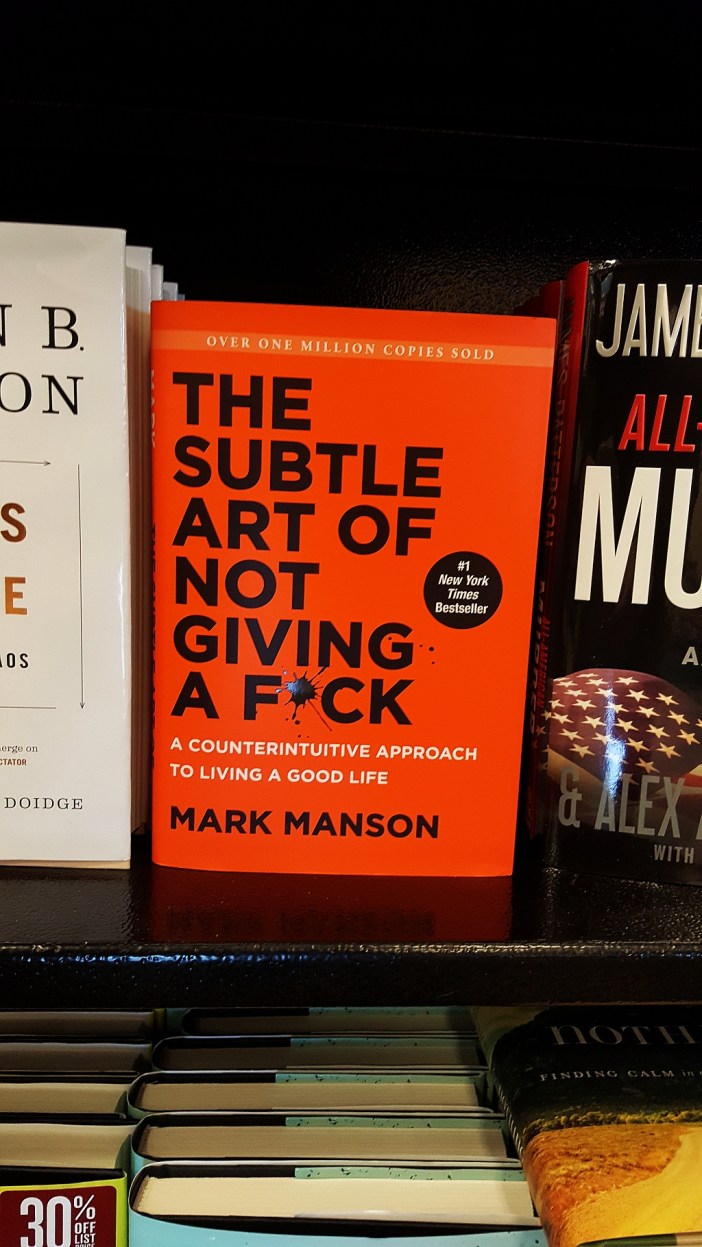
As usual, it’s taking me forever to get to my main subject.  I’m really hoping to blog about a book that I saw while working with my Venezuelan friend this morning.  It was shelved directly in front of the table we were sitting at.  Its title—one of the best I’ve seen adorning the cover of any book in recent memory—The Subtle Art of Not Giving a F*ck:  A Counterintuitive Approach to Living a Good Life— immediately grabbed my attention.

bn1

As soon as my English lesson ended and my student had taken off, I walked over to the shelf and got a closer look.  I saw that it was written by Mark Manson.  I picked it up, opened up to the first page, and saw a reference to Charles Bukowski.  (The author immediately scored bonus points with me.)  I then turned it over and saw that it was selling for $24.99.  Because I am a cheapskate by nature, I decided I’d see if I could find it at any of the libraries I have access to.  Free, in my way of thinking, is always preferable to $24.99.

bn 2

This is certainly a book I very desperately need to read.  For almost my entire life—I did have a brief “bad boy” phase that doesn’t count—I’ve given too much of a f*ck.  From just about the moment I exited my mother’s womb, people have used words like “conscientious,” “responsible,” and “meticulous” when describing me.  Of course, these aren’t necessarily bad things, but when taken to the extreme, such attributes can turn one into a neurotic perfectionist who obsesses about everything.  Such a person wakes up at 3 a.m. in a cold sweat because the water bill is due in less than five hours and the possibility that the online payment might not be processed in time fills him with existential dread.

Such a person is me.  That’s yours truly in a nutshell.


I Love My Job!

inrw lc.jpg 2

About four months ago I was hired to manage the Integrated Reading and Writing Learning Center (INRW LC) at Palo Alto College (PAC) in San Antonio, Texas.

“INRW” stands for “Integrated Reading and Writing.”  Our center is a place where students can come to participate in reading and writing workshops and get hands-on tutorial help with tasks that have been assigned by their INRW instructors who teach in the Department of English.

I absolutely love the job for a whole bunch of reasons.  For one, I get to supervise several extraordinarily talented tutors and oversee the daily operations of the INRW LC.  I also get to design and lead workshops as well as work with student-writers on a one-to-one basis.  They bring drafts of papers they’re composing, and I act as reader and consultant as they go through the writing process.  Our ultimate goal, as we work collaboratively, is to have them produce pieces of writing they’ll be satisfied with and that will receive positive evaluations once they’re turned in.

Before coming to PAC and the INRW LC, I was employed as a lecturer in the Department of Rhetoric and Composition at the American University in Cairo (AUC), a position I held for seven wonderful years.  What I like about my current job is that I still have the opportunity to teach but get to provide more personalized assistance, thus turning teaching and coaching into acts of great sharing and intimacy.

Students often ask me what it takes to become a really good writer.  There’s a lot that goes into answering such a question, but if I’m forced to boil it down, I’d say that the single most important thing a person might do to get better at writing is to focus on becoming a more skilled thinker.  I make this claim because writing is really just thinking on paper, in a visual form that can be shared with others.

In my case, I started getting much better as a writer when I became a graduate student and professors started pressing me intellectually.  By holding me to a really high thinking standard, I had to evolve as a communicator because words were the things I was using to share the ideas I was positing.  If I wanted my ideas to be compelling and precise, then my language had to be compelling and precise.

Graduate school is Boot Camp for would-be intellectuals, and my professors were working hard to turn me into a kind of Thinking Ninja.  I was being tested and stressed and worked out so that I could become formidable.  Because we live in a world where ideas matter, the strongest ideas, presented the most strongly, end up mattering more.  Those who hold them and become skilled at sharing them, become very powerful.

This is why I ask so much of all the students I work with.  I want to empower them.  I want to help them gird them for battle.

I’m the Boss (and So Is Bernie)

I want to start by saying something that should be obvious to everyone:  I’m the boss of this blog.

Oddly enough, even though I’m the owner and CEO of Thinker Boy, Inc., it wasn’t entirely obvious to me, though.  My most recent posts, all of them personal reflections on my profession—I’m a teacher—had started to feel stale and I was growing bored while writing them.  Still, I hadn’t turned away from the topic because I had promised to complete the project.  Guess what?  I’m going back on my word.  I’m discontinuing the series of blogs I’d been calling “The Accidental Teacher.”

I blog a lot like I travel.  When I go somewhere as a tourist, I never make a plan before arriving at my destination, nor do I carry a guidebook.  I like to arrive in a state of naiveté, which assures that I’m going to be surprised as I roam around.  When traveling like this, I wander upon an interesting spot, one I’d never expected to find in the first place, and stop to look for a while.  When the time feels right, I turn my back and walk away.

I’m using this analogy to tell you that I’ve been looking at the topics of “education” and “my life as an educator” long enough.  I’m now ready to stroll away from them and make new discoveries.  I guess I could be a more focused writer if I were a more focused person.  Part of the reason I’m unfocused is that I have so many interests.  I’m all over the place and so is my blog.

One of my interests is American politics.  Lately, I’ve been obsessed with the competition between Bernie Sanders and Hillary Clinton.  (FYI:  The Republicans only interest me to the extent that their current crop of candidates are capable of disturbing my sleep by giving me nightmares.  One of them in particular—I think you know which one I’m talking about—seems hellbent on causing the whole sane world to have really bad dreams.)

I’m a Sanders guy and I FEEL THE BERN every day of my life.  If you want to follow my thoughts on the contest, go to my Twitter page and have a look.

My Egyptian wife and I live in San Antonio, Texas, and we are very active people.  While moving around and through Texas’ second largest city, we see many streets with houses that have Bernie Sanders signs in their front yards.  To date, I have not seen a single Hillary Clinton sign even though she won the Texas primary a while back.  Who are these Clinton supporters and where are they?  They sure seem like a shy bunch, at least in these parts.

In an attempt to get to the bottom of what motivates HRC supporters, Camille Paglia has written an interesting piece with a very provocative title—“Enough with the Hillary Cult:  Her admirers Ignore Reality, Dream of Worshiping a Queen.”  I wholeheartedly recommend that you read it.

Sanders is constantly calling for a revolution in America.  By this, he means we need to revolutionize our thinking.  Sanders, of course, would never ask others to do something that he hasn’t already done himself.  If you want to see what he means by this sort of thinking, watch the video below—it’s the speech he gave at the Vatican—and you will certainly see a politician who has embraced the sort of progressive ideas that many would find revolutionary.

When was the last time you heard a candidate for president talk about the weak and downtrodden and argue that America’s profits-before-people economic system is “immoral” and even “unsustainable?”  If you can’t hear the voice of saint—or a jewel of a politician—when Sanders speaks, you need to get your ears checked.  You might want to check your ticker too—to make sure you haven’t become heartless.

We in the 99% are those who Sanders is looking out for and talked about in Rome.  By running for president, he’s throwing us a lifeline and we need to be smart enough to grab it.  If we don’t, we may find ourselves sinking to the bottom of the deep, blue sea.


The Accidental Teacher: An Essay and Memoir (Part 9)

I have had a pretty unique job during most of my adult life.  I have been a teacher—for what seems like forever now—but I’ve never really been the sort who wanted my students to become more knowledgeable, which I associate with acquiring information.  Instead, I have tried to help them hone skills that promote wisdom or shrewdness.  In other words, I haven’t focused on what they should know but on how they should know.  “How” one knows is often referred to as thinking.

Most people believe that thinking comes naturally to everyone because we’re all born with brains.  It’s true we’re born with this organ, but there is a world of difference between run-of-the-mill thinking and critical thinking (or good thinking), just as there is a world of difference between the sounds made when my untrained fingers hit the keys of a piano and the music produced by a world-class concert pianist when his or her fingers touch the ivory.

There are a million things which interfere with good thinking.  At the moment, I don’t have time to get into all these factors.  The old saying, “The apple doesn’t fall far from the tree,” explains one of the most important influences on our intellectual development.  Most grow up thinking in the same way their parents did and thus believing in the same things too.  Our parents are our first models and their influence leaves a deep imprint.  To be able to “fall far from the tree” requires that we have to, at some point, question our parents’ way of seeing the world and this takes great courage.  In fact, there is no activity in life that requires more bravery than to think critically because to do so one must sometimes say “no” when important others (or maybe even the whole community or world) is saying “yes.”  Saying no when others are saying yes can be costly or even dangerous.  It’s certainly easier (and more comfortable) to just go with the flow.

I’m thinking a lot about thinking these days because that’s what I do.  Plus, it is campaign season in America and that means the news is full of stories about powerful and ambitious people putting their thinking on display in an attempt to get others to vote for them.  In the interest of full disclosure, I’ll just go ahead and tell you that politicians with the most progressive points of view generally tend to think a lot better—I’m not talking about their ideas, which I also find attractive, but about the methods they use to formulate their ideas and then state them to the public—than do conservatives.  Political conservatives—I actually like to call them “regressives”—make a lot of very classical thinking mistakes that many others might not catch because they aren’t trained to look for them the way I am.  In fact, regressive politicians often make arguments that simply leave me shaking my head.  The fact that so many Americans find such unskilled thinking attractive often makes me despair about the future of the country.

At this point I should probably tell you that I made myself a promise several years ago.  I promised to do whatever was necessary to become the best thinker I could possibly become even if this meant that I would ultimately have to embrace very unpopular ideas.  In my attempt to constantly improve myself intellectually, I often find myself butting heads with what is called “conventional wisdom,” which is mostly a first-rate oxymoron.

I want to conclude by reiterating something I said in a previous blog.  Critical thinking is a way of being.  It is a method of living life with great integrity.  It is not something I turn on and off at will.  It has become the way I conduct myself in this world.

The Accidental Teacher: An Essay and Memoir (Part 8)

I may have become a teacher by sheer accident, but that doesn’t mean I’m not willing to vigorously stand up for my profession or for my colleagues in the trenches.  By the way, many of these colleagues do incredibly important work under tremendous duress.

In “Teacher Autonomy Declined over Past Decline, New Data Shows,” Tim Walker writes that “classroom autonomy is a major factor in determining level of job satisfaction [among teachers]” because “it speaks to whether educators are treated as professionals.”  In other words, taking away teachers’ freedom of self-determination sends a very powerful message to those who are on the losing end of the stick.  It says we no longer trust you to make important decisions about how you do your work.  We think you are incapable of acting responsibly on your own or thinking for yourself.  We are worried that you’re going to do and say the wrong things.  So, to keep this from happening, we will provide you with a script and ask you to do nothing more than read from it.  Memorize your lines, and for heaven’s sake, don’t improvise.

Is it any wonder that so many teachers are feeling so demoralized?

Listen.  Teachers are not stupid people.  They have been educated in fine universities and deserve the sort of respect given to those with similar credentials who work in other fields.  This whole push to turn educators into functionaries (or automatons or script readers or whatever term you want to use) tells them everything they need to know about how their bosses view them.  If their “superiors” really thought they were entirely capable, then scripts and such wouldn’t be needed.  After all, a script is a kind of crutch that is given only to those who are deemed incapable of walking on their own.  Am I right?

This loss of autonomy isn’t just happening at public schools.  In fact, it happened at my last two university gigs—at Bilkent University in Ankara, Turkey, and at The American University in Cairo, in Cairo, Egypt—places where I was hired to teach credit-bearing writing, research, critical reading and thinking courses to first and second-year students.  Though both cases were bad, the most grievous took place in Egypt.

When I was first hired by the Department of Rhetoric and Composition at AUC, instructors were allowed to design they own courses as long as they helped students meet a broad set of learning objectives.  These educational goals included helping pupils become better thinkers as a result of developing their critical reading, writing, and research skills.  Everything was fine during my first two or three years in the department.  About the fourth year I was there, though, something began to change.  Someone (or some group)—decision-making was kept pretty opaque so none of us had any real idea who was pulling the strings—decided there was too much variety in the kinds of classes being offered.  (No evidence was provided to demonstrate that this variety was having any sort of detrimental effect on students or their abilities to function within the university.)  Anyway, eventually this decision led the department to create a very prescriptive course template that was handed out to all.  Teachers could still apply to design classes provided that their proposals met a very set narrow set of parameters, many of which made no sense to most of the faculty, especially to those with many years of teaching and course development experience.

I decided to play along and turned in a proposal only to have it rejected.  This came as a shock to me since I had been a successful course designer for more than twenty-five years.  Over these decades my creations had been looked at my many dozens of sets of eyes and had passed all sorts of scrutiny.  Additionally, many of my classes had been deemed so well put together and successful that they had been offered as models to other instructors, even to those in the Department of Rhetoric and Composition at AUC, the very place that was now telling me my newest proposal was a failure.

So, for the first time in my professional life I was not allowed to create a course and ended up teaching from a syllabus that was simply handed to me.  Needless to say, I never really believed in the class—I’m a veteran who has trouble teaching unless I feel that I have “ownership” of the thing being taught.  I’m sure this lack of passion manifested itself in many visible ways, which meant students could feel, from day one, that my heart wasn’t fully involved in the project.

Two semesters later, I handed in a letter of resignation and shortly thereafter said goodbye to the school after seven years.  I was certainly not alone in my decision to leave.  As a matter of fact, the department lost twenty-five percent of its instructors the term I departed.  This, by the way, was an unprecedented loss and should have sent a strong message to those in charge.