YES!

I want to start with an apology. I’ve been incredibly busy lately and thus unable to spend much time writing.

A couple of days ago, I managed to find a free moment, so I started a new blog, just about finished it, and then ran into a really cool article that inspired me. So I set the piece I was working on aside and will come back to it in a few days, after I’m done with this one.

If you haven’t already done so, look back at my last blog—“Speaking of Politics…”—an article on why I’ll be supporting Bernie Sanders in the upcoming presidential plebiscite. Some of what I write here will relate to some of the things Sanders says in the video I embedded in that previous entry.

If you click on the above link, you’ll be transported to a piece in The Atlantic about a fellow named Scott Santens who is described as “a leader” in the “Basic Income Movement,” which calls for government to provide enough money to every citizen so that their basic needs will be met without having to work. By the way, movements of this sort are gaining momentum in many countries of the world as this video, produced in Switzerland, makes clear.

The article and video got me thinking about how my life would be different if some entity—the government, let’s say—guaranteed me enough money each month so I could be jobless if I wished. Would such a program turn me into a lazy slob?

Absolutely not. I feel completely confident saying that I’d spend a lot more time doing creative things, like writing and publishing, if I had fewer employment worries and commitments. I’d spend more quality time with my wife and family and would become a better husband, son, brother, and so on, in the process. There are causes I care a lot about, so I’d definitely give some volunteer hours, each week, to help those in need. Actually, I’d probably be more active than I currently am because I wouldn’t be so tired and stressed out all the time.

I think, in my case, society would probably get a pretty good return on its investment. I’d certainly continue to “work” but at things I had true passion for and was talented in doing. Contributions, toward the greater good, would come from this and I’d be more likely to feel something akin to self-actualization, in the sense that Abraham Maslow intended. As a result, I’d be happier and more prosperous. A country full of such individuals would certainly have a lot more stability than more hardscrabble places. And in a world full of nations filled with disgruntled citizens, that’s worth a whole lot.

Speaking of Politics…

Many of us had high hopes when Barack Obama was first elected. We thought he would be different. In a few small ways, I suppose he was. His name, after all, sounded unusual. And, of course, his skin pigmentation was not what we were used to in our presidents. There were plenty of signs he wasn’t your average WASP.

Right from the beginning, conservatives worked themselves into a lather. They argued—most of the time with a straight face—that Obama was the anti-Christ. He was on a secret mission to destroy the nation from within and was allied with Muslims and/or Communists in carrying out his evil plan. Now, nearly eight years later, we find that he didn’t actually take America’s guns away. He didn’t create a One-World Government and invite in the “Black Helicopter” bunch. Nor did he introduce Sharia law. I wonder what happened.

Now that the Obama lease is about to expire, we find ourselves in the beginning phases of finding a new tenant for the White House. As we go forward, I have one wish for the nation: That we continue to expand our thinking about what makes a good American president.

Open-mindedness and innovative thinking should come natural for a country as large and diverse as the United States. Even the nation’s symbols suggest a need for this. The American flag, after all, has fifty stars, suggesting multiplicity. It’s downright un-American to engage in groupthink or to close the door on certain ideas or to certain types of presidential candidates.

All this brings me to Bernie Sanders, a fellow hailing from a small state but who thinks really BIG. I’ll cut right to the chase and tell you he’s the guy I’ll be voting for. Actually, I’ll go even further than that. He’s the guy I’m going to tell others about.

I don’t normally watch shows like “Face the Nation” because they mostly invite very mainstream, unimaginative guests who offer us the same old tried (and failed) solutions to the nation’s problems. Still, having said that, I’ve included a clip because it features Sanders.

We all know that Bernie’s opponents are going to try to discredit him. They’ll call him “weird,” “effete,” and probably “soft”—on all sorts of things. They’ll call him “liberal” and very “European.” The list of terms they’ll use to describe him will undoubtedly be a very long one. On top of all that, they’ll even try convince people that he’s “scary.” But, honestly, were you frightened by anything you just heard?

Here’s what you should be scared of, especially if you belong to America’s middle and working classes. You should be terrified by the status quo—more “trickle down.” That’s been tried again and again. And we know how it turns out. The roots get starved and the whole plant withers.

And Now a Break from Our Regularly Scheduled Programing

So I was dining in this Indian restaurant a few days ago. We’d pushed a couple of small tables together as we were a party of seven. Six of us were Americans and the seventh, my wife, was Egyptian. We weren’t drinking alcohol or anything, but the conversation was still silly and random as hell. Many of us giggled and guffawed as the talking occurred. If my memory serves me correctly, I believe there were even a few instances of people chortling. That tells you what kind of evening it was.

At one point, just before the food was brought to the table, Ruthann, a fellow Texan from Dallas, turned to me and said, in a voice loud enough for everyone to hear, “Let’s talk about obscure celebrities from yesteryear.” That prompted me to respond, “Hey, does anyone know whatever happened to Tiny Tim?”

Of course, Azza, my better half, had no idea who this miniscule person was. One other individual, a child of twelve, was equally in the dark. Everyone else immediately fell silent. You could literally hear cogs turning in heads as people thought about my question.

I was the first person to break the silence. I said, “Tiny Tim is actually an interesting study. He’s a study in how far an untalented person can go in show business.”

“It wasn’t necessarily that he lacked talent,” Lori retorted, “It was just that he had the right sort of talent for the 1960s.”

“Right,” said Ruthann. “Weirdness was really in in the 60s, so he had what people wanted.”

I’ve embedded a video so you see an example of what Mr. Tim provided to the public during his heyday.

Now, days later, I’m almost embarrassed to admit it, but I’ve been spending a lot of time thinking about Tiny Tim. In addition to the clip I included, I’ve looked at a zillion videos of him performing and being interviewed. I even called several teaching colleagues into my office, showed them a few of the things I watched, and asked them to respond, taking careful notes as they spoke. Like I said, I’ve been a bit obsessed recently.

Perhaps that was his ultimate goal (and genius?) as a performer? To create a persona and a sound we couldn’t turn away from and couldn’t get enough of?

The Third Reason

Two blogs ago I said we had two reasons for traveling to Dahklah Oasis and Ain El Oda in southwestern Egypt. I failed to mention that we also wanted to check out and purchase some of the wonderful handicrafts the region is so well known for.

I should back up some and tell you that Azza, my Egyptian wife of three years, is in the home stretch of receiving her green card. About fifteen months or so ago, we hired a fancy immigration lawyer, with an office in Austin, Texas, to help us start the process. I’ve been living in Egypt for seven years now, but recently, let’s say in the last year and a half, the security situation has gotten so that it’s now time for us to get out of this part of the world while the gettin’s good. This point was recently driven home when we had a bomb blow up on our street, not more than a hundred yards away from our apartment building, which is located in Maadi, a suburb of Cairo and a part of the city once thought to be immune from the sort of political violence that is wracking this country and the entire Middle East-North Africa region.

So what does this have to do with us wanting to look at handicrafts in rural Egypt? Well, we’ve been thinking that we might start an import-export business and bring a bunch of super cool decorative items into the US to sell. The Egyptians are not as well-known as the Turks or Iranians for their rugs, but they make some mighty fine ones. And they produce hand-tooled metal light fixtures that are simply to die for. Applique, pottery, furniture, and hand-blown glass can be added to the list of things produced by Egyptian artists and craftspeople.

In this piece I want to focus on baskets and basketry. During our visit to the oasis, we picked up a few of these vessels to add to our collection. They are exquisite examples of the craft and the sort of decorative item many Americans would simply go bonkers over. Don’t you agree?

Finding Albuquerque and Santa Fe in Unexpected Places

I’m pretty sure my visit to Ain El Oda was unprecedented. Never had a non-Egyptian stepped foot in the place. And then here I came, an actually American, wandering the unpaved streets and taking in the sights.

As you might guess my sudden appearance created quite a stir. On about the second day I began to catch villagers sneaking peeks at me. They’d hide behind donkey carts and such. All I’d see would be a curious eye, often wide with amazement, peering out from some dark, secretive place.

Azza’s family’s reaction to my visit was sweet. Many tried their hand at speaking English, not having uttered a word of that foreign tongue since graduating from school. People wanted to give me things. The fatted calf was killed and great pots of food were heaped upon the table. They wanted to make sure that my glass was always full. Did I want a little taste of homemade cheese? How about some fresh bread?

They also planned a lot of events. So, every afternoon and evening, they’d load me into a car and shuttle me around. I think they were worried I’d find the place too off the beaten path, so they wished to assure me they had places to go and things to see too, just like the larger world did.

I was driven to see two nearby hotels and given tours of each one. Both were funky-cool by any set of standards a person might want to apply. One of the places was called Badawiya Dakhla Hotel and was situated in El Qasr, an ancient place known for its wonderful folksy handicrafts. The other was Al Tarfa Lodge and Spa which is owned by a member of Sawarises, a family with pockets so deep their bottoms cannot be seen without the use of a high-powered telescope.

I’ve included a selection of exterior and interior photos. Note how reminiscent the buildings are of New Mexican adobes.

Sitting with Khadra

Azza and I are very tired today. Last night, around 10 p.m., we returned from a week-long road trip across a good portion of Egypt. We made this journey—a bumpy and sandy one—in a tough-as-nails Jeep Grand Cherokee owned and driven by Magdy, my wife’s oldest brother. Accompanying us was Basma, Magdy’s wife, Zeineb, Azza’s mother, and “Mehdu”—short for Mohamed—Zeineb’s youngest grandson.

The purpose of the trip was twofold: have a Spring Break adventure and visit a number of Azza’s uncles, aunts, and cousins, a sweet bunch of country folk who reside in an area of southwestern Egypt known as the Dahkla Oasis. To get a sense of where we went, find El Kharga on the map (see below) and then go west from there until you come to a place called El Qasr. That’s about where we ended up. The village we actually stayed in is not depicted. It’s called Ain El Oda.

physical-map-of-Egypt

If you’re into distances and that sort of thing, that’s a thousand miles, round-trip, across potholed highways that occasionally disappeared due to the creeping encroachment of mountain-sized sand dunes. In fact, portions of our sojourn could realistically be described as “off road.”

I envision this blog being the first in a series about the trip. What I did in Ain El Oda, and its environs, and the people I met there. My impressions. That sort of thing.

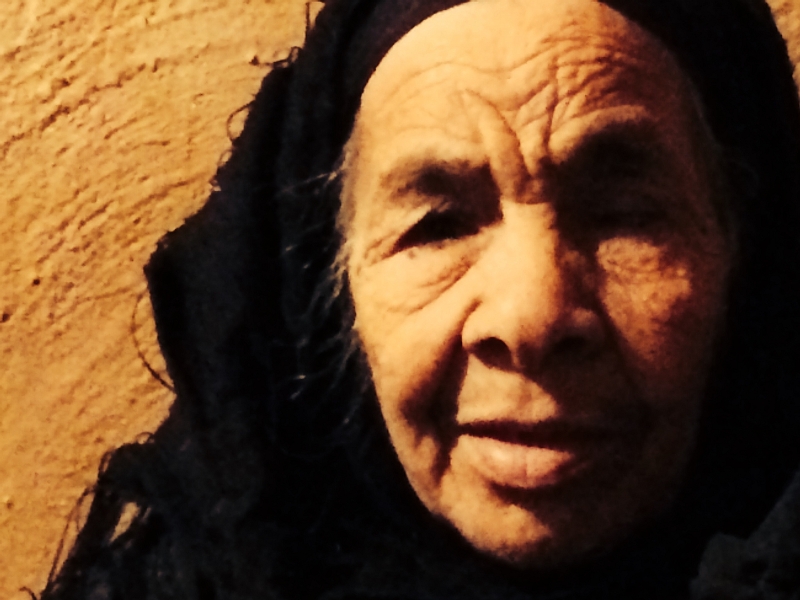
I’d like to do this first one on a woman named Khadra, one of Azza’s great-aunts.

I first met Khadra on her bed in the room where she slept, a dark space, made of Egypt’s version of adobe, with a dirt floor underneath our feet. The ceiling consisted of raw timber rafters and more mud. The bed was pushed up against one of the walls and the door was standing wide open, allowing flies to freely enter and exit. Semiha, one of Khadra’s daughters, was visiting her mother when we arrived. Of course, we all greeted one another in typical Egyptian fashion—a kiss applied to one side of the face and then the other, alternating like that until three or four smooches had found their mark.

There were no chairs so we simply sat on the bed itself. Khadra was wearing mourning black—Azza later explained that she’d dressed herself in this color nine years earlier, at the loss of a close member of the family, and just about the time she was ready to return to her regular attire, one of her sons died. Those traumas had been enough to cause her to grieve in perpetuity. Before the end of that initial visit, I asked Azza to ask Khadra how old she was. Khadra thought for a moment and then shrugged her shoulders. She wasn’t for sure. Eighty something, she guessed.

Khadra in her Bedroom

I immediately felt a strong kinship with Khadra. She talked about her physical ailments but never seemed to dwell on them. She had this marvelous way of suddenly turning toward me and looking me straight in the eyes before sending countrified Arabic my way. Of course, I wasn’t able to understand most of what she said, but Azza kept translating. Her utterances often had something to do with how happy she was to meet me and how glad she was Azza and I had gotten married.

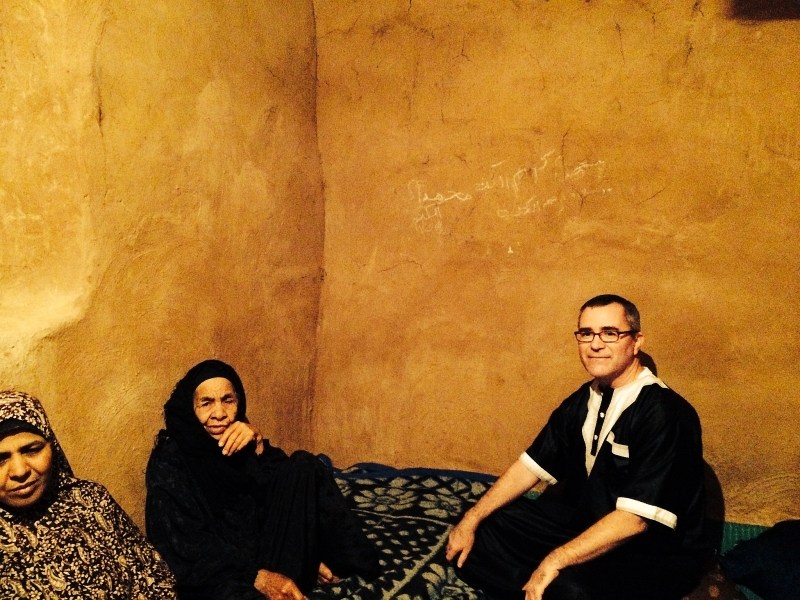
In the evenings we made sure to return to Khadra’s place for a bit of socializing. After dark she’d leave her bed and go to the “sitting room,” a space that included a small television which she completely ignored. Instead, she would busy herself by talking with the ten or so visitors who’d come to say hello.

Visiting Khadra
Visiting Khadra

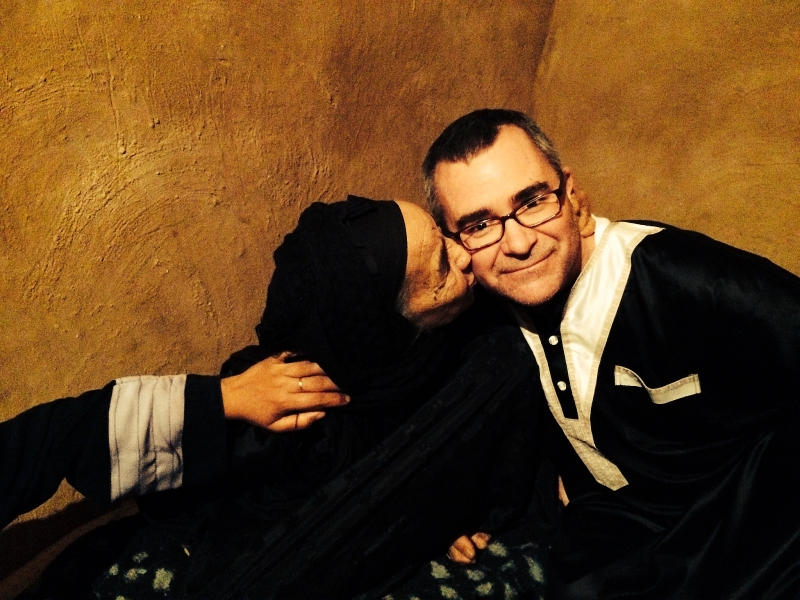
At one point, I told Azza to tell her great-aunt that she reminded me of my maternal grandmother, a woman I’m sure I’ll eventually blog about. As soon as she heard that, Khadra smiled and her face lit up. I’d given her such a compliment that she insisted I allow her to give me a kiss. Of course, I immediately obliged. Luckily, Azza had her camera at the ready and was thus able to digitally capture the moment.

Khadra Kissing Me
Khadra Kissing Me