The Accidental Teacher: An Essay and Memoir (Part 3)

I grew up just north of a tiny community called Georgetown, Texas, a sleepy place of approximately five thousand inhabitants. The nature of the village was such that it was easy for its citizens to live dreamy lives.

I have vivid recollections of the town, as it used to be before it became fast-paced and congested, before it became Austin’s premier bedroom community. Today, the town—it’s more of a city really—is on fire with development. The few old-timers who still live there speak wistfully of a slower and simpler past.

But, back in the day, it was a quiet village, filled with grand Victorian houses that were shaded by tall pecan trees. There was a stop sign or two and maybe a traffic light. People got their groceries at the little Piggly Wiggly and their clothes at Gold’s Department Store on the square. There were a handful of churches and every family attended one. The schools weren’t crowded, nor did they resemble the fortresses of security that we so frequently see today when we drive past one. I guess it was pretty much Central Texas’ version of Mayberry R.F.D. I realize I’ve dated myself some with that reference to The Andy Griffith Show spin-off. I remember a slew of other programs that are part of the lore of 1970s television. Such is the memory of a man my age.

When my parents broke up, I moved, with my mom and brother, to Forsan, Texas, with the result being that I left my life in a small town to start anew in an even tinier one.

The point of all this is that I came of age in conventional places where people never dreamed of entertaining thoughts that were the least bit radical. Most citizens of Georgetown or Forsan didn’t even know what they didn’t know. The vast majority of children grow up similarly, I suppose, in places like I’ve described. It is universally true that the family and the local community give us our shape. By “shape,” I also mean our “limits.”

When I went off to university, I was a small-town boy who was intellectually stunted due to no fault of my own. But because of the influence of those individuals I mentioned in my previous blog, I was also the fertile ground into which the seeds of all sorts of new ideas could be planted. So, when I registered for classes like philosophy, political science, sociology, psychology, and literature, strange flora began to sprout and the terrain of my mind was changed forever.

The Accidental Teacher: An Essay and Memoir (Part 2)

1986 was my rookie year. All these years later, I’m still in the teaching game. You could easily refer to me as a grizzled veteran without running the risk of exaggerating. You might also call me an old crank. I’ll answer to pretty much anything.

All these years of experience have provided me with ample opportunities to think about my profession, and I’ve even had an insight or two while doing all this cogitating. For one, it seems that there are basically two types of teachers: Those who chose to get into the profession and those who happened into it by sheer accident. This second bunch I call “Accidental Teachers.” As the title of my essay and memoir makes clear, I certainly consider myself a member of the latter group.

Not long ago, during a Thanksgiving get together, I had a conversation with Betty, the wife of one of my cousins. Several months prior to this talk she had completed her degree in education and was now teaching at Central High School in San Angelo, Texas. She told me all about how her new job was going, what her students were like, and stuff like that. She also revealed that she had always dreamed of being a teacher. When I heard her say this last bit, about she’d always wanted, from the cradle onward, to stand up in front of students and spout, I felt momentarily dumbstruck. It was because her experience was so different from my own. Once this first feeling passed, I felt as if I wanted to congratulate her. She had dreamed of doing the very thing she had ended up doing. I would imagine that’s a pretty rare accomplishment in these United States of America, which might explain why so few people are really happy about the work they do.

Unlike Betty, I had not always (or even ever) wanted to work in the classroom. I had grown up wanting to learn, though, and I owe several members of my family a huge debt for having helped me become the curious person I’ve always been. First of all, there’s my mother, a woman who brought me into this world and then proceeded to carry me around when I was a wee tyke. While doing so, she would point at things and help me really see them for the first time. She would then tell me what these objects were called. I am almost certain this is why I later became so intrigued by words and language and such. Secondly, my father, the dreamy artist and philosopher, helped me learn about the power of the mind and the will to create new and beautiful things. From him, I learned quiet introspection and deep observation. Thirdly, my maternal grandfather, a man now dead for many years, instilled in me a love of current events. He was an opinionated fellow who loved to reason and make arguments. Even though he had little formal education, I still, to this very day, think of him as one of the most influential people I’ve even known as far as my intellectual development is concerned. For example, he instilled in me a deep fascination with politics and international affairs.

These individuals prepared me well to enter school and do well once I got there. I grew up a pretty capable kid, and then I went off to college and fell in love with studying all manner of esoteric subjects. It was this fascination which became a double-edge sword. It both set me free and left me enslaved.

The Accidental Teacher: An Essay and Memoir (Part 1)

In the fall of 1986 my life took a turn. I’m in a pretty good mood today, so I won’t say it was a turn for the worse. Ask me tomorrow, though, and I might describe it as a swerve that took me right up to the precipice. It’s all a matter of perspective.

In the fall of 1986, I became a new graduate student in the Department of English at Texas A&M University. The head of the department met with me in person, shortly before sending my acceptance letter, and told me he found my academic performance, as an undergrad, praiseworthy. As a way of demonstrating how impressed he was, he offered me the job of “Graduate Teaching Assistant”—or GAT, which rhymes with GNAT, an interesting similarity given that both are located quite far down on their respective food chains. This meant I would be both a student and a teacher. Of course, I said yes to the offer.

The department then handed me a textbook and a syllabus and pointed me in the direction of my classroom. The assignment I’d gladly accepted—but began to feel less and less confident about as the start of the semester neared—consisted of teaching two sections of a course called “Introduction to Freshman Writing,” or something very similar to that.

In truth, I was scared shitless about the whole teaching thing but was happy to have the job. That’s because they promised to pay me almost nine hundred dollars per month. Today, that sounds like nothing—and it is—but to a poor student—one so underfed that the outline of his ribcage routinely showed through his shirt—the sum promised groceries in the fridge and thus three squares a day.

The day before my teaching job was to begin, I tried hard to imagine what it would be like having so many faces staring at me from so many rows of desks. Then the actual first class happened and it was even more traumatic than I’d ever dreamed possible. The expressions on the faces of my students suggested that they expected me to say important things and give them helpful guidance. This meant that they actually thought of me as a real instructor with knowledge and ability and such. This fact scared the hell out of me and made me question all sorts of things, including the sanity of those who’d hired me.

Needless to say, I was terrible during that first term. What I did in the classroom should in no way, using the most liberal definitions available to us, be called “teaching.”

Here I am, these great many years later, still in the classroom and still wondering if I’m good enough. (Evidence suggests that I’m a hell of a lot better than I was when I first started.)

The following blogs will tell the story of the teacher who never should have been a teacher and will chronicle my growth in the profession.  They’ll also be about the foreign places my teaching career has taken me and the insights I’ve gained while doing this work. I hope those who read the blogs will find them interesting, humorous, and maybe even a bit thought-provoking.

Waking Up

on the riverwalk

It’s been really hard to shake the feeling that I’ve just woken up from a really long sleep. That’s because these recent weeks seem so dreamlike, so unreal, or perhaps, even surreal.

Just about eleven weeks ago to the day, I got word that a company that hires civilian contractors for the US military was interested in employing me to do educational work of an intercultural sort. This news came suddenly, while I was visiting my sick grandmother in West Texas. The job offer came with one stipulation—that my wife and I relocate to San Antonio, Texas, within a matter of days.

So we packed up, quickly. We were only able to take with us the few things we could fit into our Subaru. I managed to get online and was able to reserve a room in a place called Studio 6 Extended Stay—an old Motel 6 facility that had decked out a number of its rooms with kitchens and cooking utensils.

We moved into the place, bought groceries to fill up our fridge. The following day, I started one of the most intense orientation and training programs—along with seven other trainees—ever devised by human beings. I arrived at my new workplace a few minutes after 6 a.m. each morning. Our days were filled with “briefings” and then we did all sorts of practice teaching that was observed by a large number of people who wrote up reports on what they’d seen us do. We were like lab rats sent running through mazes in search of chunks of cheese. Not all of us passed these early tests. It was boot camp for teachers and some of us were let go before the real work even got started.

I find it incredibly hard to believe that it’s been a touch less than three months since we arrived in San Antonio. In some ways, it seems like a year or more has gone by. In other ways, it seems like mere days.

I’ve been mostly exhausted since all this got started. Finally, though, I’m beginning to catch my breath. I’ve even started to wake up from this dream-state I’ve been in. I’ve mostly been in survival mode, just doing those basic things that each day required of me, but now I’m beginning to think about writing. The old creative juices are beginning to flow again. This means more blogging—of a regular sort—is in the offing.

The photo I’ve included, at the outset of this piece, is a nice one and full of symbolism. It was one of the earliest ones I took in San Antonio—on one of our visits to the city’s famed Riverwalk, downtown. In it, Azza and I have just stepped across a threshold and a dome-shaped ceiling can be seen overhead. Behind us is a wall, a waterfall, and the past. We are wearing shades as we are looking forward, toward the camera, into a bright future. We are smiling and wearing expressions of expectation. Something about us in the photo suggests that we are travelers or explorers, embarking on a sojourn that will provide plenty of wonderful surprises.


Several Thousand Tasty Words

I’m adjusting very well to living in America again. I say this because I keep having these moments where I look around and think, “I feel so wonderfully contented!” Such an experience occurred yesterday as Azza and I were sitting on the front porch and watching a cold summertime rain fall. After a particularly bright flash of lightning and then the delayed rumble of faraway thunder, I shuddered and felt completely overwhelmed by the beauty of my surroundings. I didn’t ruin it by trying to verbally express what I was feeling. I just sighed and quietly enjoyed the moment.

I’d like to share a bit more good news but of a different sort. It looks like I’ve landed a job, but I can’t write about it here because Azza would be very mad if I did because the contract is being prepared (as I write this) and thus I haven’t signed it yet. She believes it’s really bad luck to share good news prematurely. So, in a bow to her and her superstitions, I’ll just say that things are about to look up on the money front.

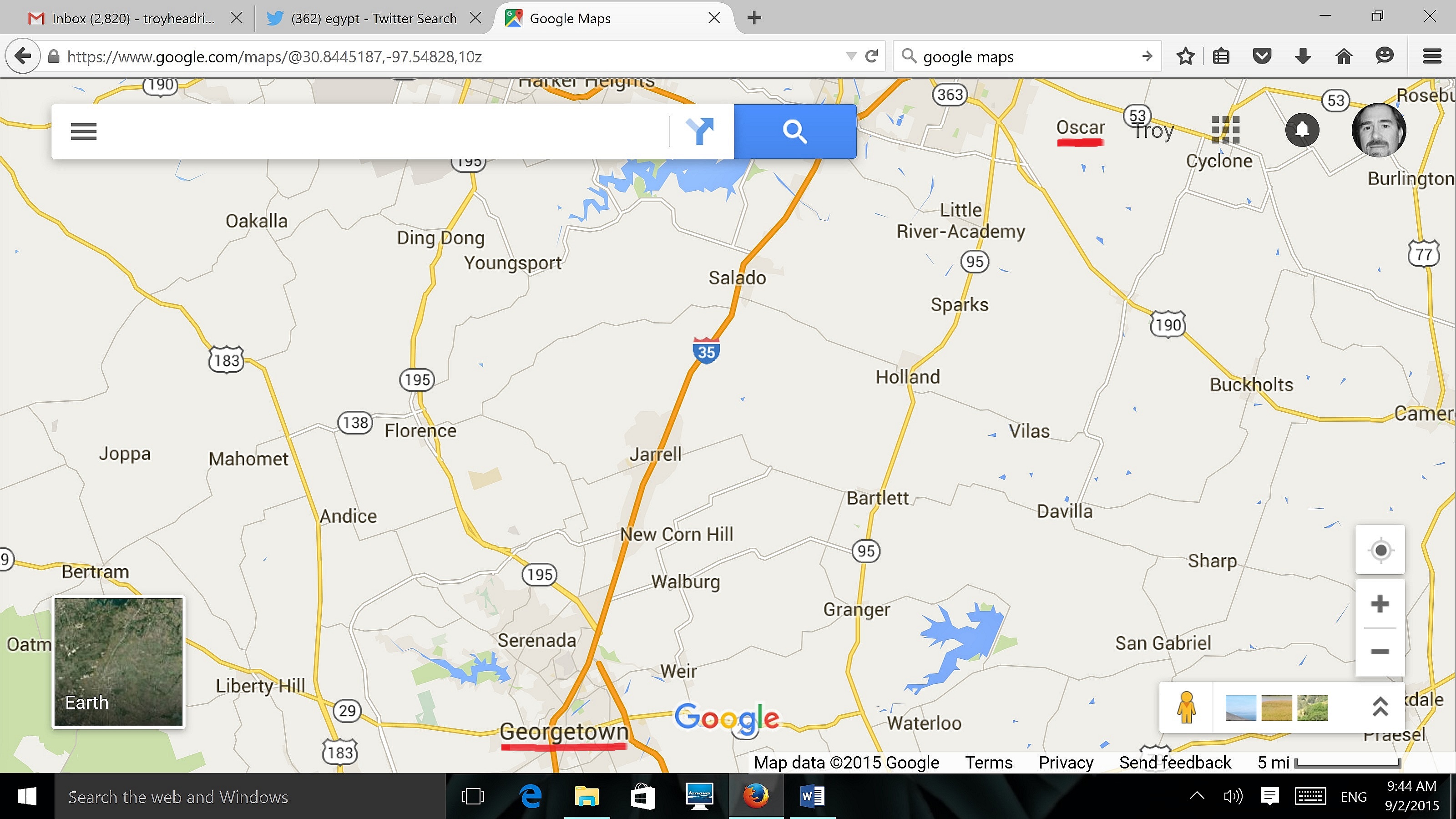
This past weekend, Janie, my stepmother, suggested that we drive over to a place called the Oscar Store, in what’s left of Oscar, Texas, to eat lunch. So we loaded up in the KIA and drove north and a bit east on Highway 95, with Georgetown as our starting point. This route took us through beautiful farmland—of a rolling-hills sort—and a handful of little Central Texas hamlets with names like Weir, Granger, Bartlett, Holland, Sparks, Little River-Academy, and Heidenheimer.

Route of Our Trip
Route of Our Trip

After about forty-five minutes or so, we pulled onto a little off-the-beaten-path road and into a grove of huge oak and pecan trees. Nestled amongst those mammoths was a sprawling structure made of repurposed barn lumber and tin. (There’s no telling how many rickety structures gave their lives so that the “store” could be born.) Actually, this page gives a bit of history on how and when the place came to be.

To make a long story short, we entered the eatery, took seats, looked at menus, ordered food, scarfed it down, paid our bill, bemoaned our bloated conditions, and then took off. We also wandered around, took a few photos, including some of a helicopter that was parked nearby; well-to-do patrons had used it to fly in to the restaurant. Because a picture really is worth a thousand words, I’ve included a few photos here.

One of the Weirdest Experiences of My Life

My life has undergone a radical transformation since the last time I posted here. I left Egypt, my home for the past seven years, flew back to Georgetown, Texas, and then moved in with my family. All this in an attempt to restart my life in the United States.

For a bit more than a month, I had to live apart from Azza, my Egyptian wife, while she awaited her green card interview with a bureaucrat in the American embassy in downtown Cairo. Federal law requires the authorities to do a face-to-face chat with potential new immigrants to see if they harbor any criminal aspirations or political ill will toward the land about to accept them into its fold. Azza did her interview with her usual aplomb and charmed the person she spoke with, proving, in the process, that America had nothing to fear if she packed her bags and moved there. (Her gift of gab is only surpassed by her skills in the kitchen.) As a result, the American government made her the proud owner of a permanent resident visa.

Azza and I now share a guest bedroom in Georgetown, and I’m busily looking for work. When I’m not sending out résumés and pounding the proverbial pavement, my wife and I spend our days going to thrift shops and rummaging around at garage and estate sales. The buys we’ve been making are meant to supplement the shipment we having coming in from overseas. Said container of personal items consists of forty-two boxes, some of them nearly the size of an old-fashioned Volkswagen Bug.

This brings me to the subject of this blog. This past weekend we drove to an estate sale located in a part of Georgetown I was totally unfamiliar with. We parked, walked up to the front door, and entered, only to find a domicile full of people pawing over the contents of the place. Azza and I separated and I headed toward one of the back bedrooms which was mostly filled with all sorts of Christmas stuff—Santa Clauses, tree ornaments, and the like, all piled up on card tables. I moved deeper into the room and found myself standing in front of a closet with its door open. I looked into it, and my eyes were immediately drawn toward a stuffed animal—a “plush” as collectors and pickers like to say—in the shape of Snoopy of Charlie Brown fame.

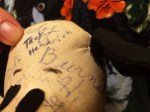
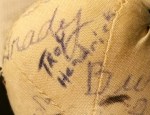
The Snoopy was completely covered with writing. As I looked closer, I could see that the toy had been autographed by dozens of people. I was shocked to see names I remembered from my elementary school days—I grew up in Georgetown before moving off to college and then farther afield. I then noticed, to my shocked amazement, my own name amongst the others and nearly had an out-of-body experience as soon as I made the discovery.

I took the plush in hand and carried it to the woman sitting at the cash register located near the front door. “Who lived in this house?” I asked her.

“The Simmons family, long-time residents of Georgetown,” she told me.

“Wow!” I said, and then I showed her Snoopy and my own signature on the dog’s head.

When I was in fifth or sixth grade, a classmate named Barry Simmons was burned in a house fire. His injuries were horrific, and he missed months of school while he was recovering. During his absence, our class bought a stuffed animal—the Snoopy I found and purchased at the estate sale—signed it, and gave it to him as a way of showing that he was in our thoughts. So, for the price of two dollars, I now own a little piece of my boyhood history.

This blog is my latest telling of this story. Everyone who hears it finds it as unlikely as I do.

I’m not a superstitious sort, but I’m hoping that the finding of Snoopy is some kind of sign, one suggesting that Azza and I are about to begin a period of many wonderful occurrences and good fortune.

My Recent Twitter Spat with a Conservative

I don’t post very much on Twitter. That’s mostly because I find it very hard to say what I want in only 140 characters—I’m generally more expansive than that. So I enjoy lurking there. It’s immediate and allows all sorts of voices, which I like.

Having said that, some voices bother me more than others do. Bigots and political conservatives are two of the bothersome kinds of people I see posting on Twitter. Actually, not surprisingly, bigotry and conservatism often go hand in hand. It’s not that I believe that such people should keep their mouths shut. It’s just I wish they would take the time to think a bit before tweeting. Or, if that’s too much to ask, then to make sure they don’t post things that are factually incorrect.

I see so many posts about Obama being a secret Muslim and/or Supporter of Terrorists and/or Communist and /or Socialist. Ninety-nine percent of the time I just roll my eyes and ignore such gibberish. It’s not that I’m in love with Obama and thus want to scream at people who say bad things about him. Actually, I’ve said plenty of bad things myself. But I generally try to make sure my criticisms are not based on obvious falsehoods and misrepresentations of reality.

I recently saw a tweet by a woman named “J_.” According to her profile, she hails from Texas and describes herself as a “conservative” and “libertarian” who loves “America,” “the military,” “guns,” and so on and so forth. In her tweet she said we have to remember that Obama “supported the Muslim Brotherhood” during their time in power. And then she included a link to this article.

I read the whole piece, including this paragraph, the sixth one, which I’ve cut and pasted below:

“Upon further inspection though, it seems that while the Egyptian qualms hold some water, the American complaints appear to be more recognizable as mere partisan discourse. The money, said to be intended for the MB, is actually for the Egyptian military and is obligated to be used to pay U.S. defense and security companies providing equipment and support for the military, according to the Guardian.”

I immediately stopped reading and tweeted a response. I asked her, “Did you even read the article?” Of course, I was not surprised by the information in paragraph six. Anyone who knows even the most basic facts about America’s aid to Egypt knows that the vast majority goes to the military, thus allowing them to buy all sorts of new equipment, a cute way of funneling money into the coffers of American companies that build armaments and such. Furthermore, since it was the armed forces that removed Mohamed Morsi from power, it can very easily be argued that by giving aid to this group, the US government played a key role in the overthrowing of Morsi and the Muslim Brotherhood.

Of course, coming to these kinds of conclusions requires a careful examination of the facts of the case and the ability to do nuanced thinking. J_ seemed either unwilling or incapable of doing either of these things. Or perhaps she was aware she was deliberately distorting the evidence and simply wanted to smear Obama. The most likely explanation is that J_ was simply too intellectually lazy to read the entire article and thus missed the key sixth paragraph.

To make a long story short, after about three more exchanges, she blocked me. Before doing that, she tweeted a response that included the hashtag #LiberalLies. Not surprisingly, she failed to see the hypocrisy of her tweet. So I pointed it out to her and then created a hashtag of my own—#ConservativeLies.

I tell this story because J_ seems to be a typical case. Conservatives very frequently seem to view facts and evidence as of little importance. They build elaborate arguments based on hunches, prejudices, things they heard their neighbor say, or whole cloth. Do you remember how George W. Bush used to talk about “thinking” with his gut?

This recent twitter exchange has got me wondering. Perhaps we progressives need to start being a lot more aggressive in confronting distortions of the sort I’ve written about here? Because we are generally tolerant people, perhaps we take it on the chin too often without punching back? Maybe, given what we’re up against, we have to start being as pugilistic as the other side?

We’re Moving

Our Stuff Boxed Up

My wife and I are leaving Egypt. This move has been in the planning stages for months now, but things got real yesterday when the shippers came, boxed up all our stuff, loaded it into the back of a truck, and then hauled it off to a warehouse belonging to Express International Group, a company that moves people hither and yon. In a few days, another eighteen-wheeler will transport our boxes to the port city of Alexandria. From there, they’ll be shoved into a container and then sent across the wide and wild Atlantic Ocean to Houston, Texas, where they will be x-rayed and ushered through customs. Yet another truck, this one driven by a Texan, will then transport them, via highway and byway, through the piney woods of East Texas to the Austin area, their ultimate destination. The next time we see our things, it will be in a totally different context.

These days my Egyptian wife needs nearly constant reassuring so I keep telling her that we’ll never entirely be separated from this part of North Africa. This is her birthplace and her becoming the owner of an American passport certainly will not change that fact. So we’ll always return. We’ll always be in contact. I will continue to learn the local language even when I don’t hear it being spoken as often as I do now.

Yesterday’s pack up was harder for my wife than it was for me. I am merely attached to this place via marriage and employment. Her roots run much deeper than that, and I sometimes worry about how well she’ll take to being pulled up and transplanted.

Don’t get me wrong. I’m not saying yesterday was easy for me, not by any stretch of the imagination. Things felt very final as our house emptied out, box by box. And this place, more than some of the other countries I’ve lived in, has gotten inside me over the years. Egypt can do that to a person. Living here can be transformative. It certainly has changed me, in more ways than I can ever fully describe here.

I first came to Cairo in August of 2008, three plus years before Hosni Mubarak was unceremoniously kicked out of office. During the uprising against his regime, I stubbornly stayed on even though most foreigners were fleeing by the thousands. I saw and did things I never thought I’d see or do as those momentous historical events unfolded. After Mubarak’s departure, there was a brief period of euphoria. Egyptians felt like anything and everything was possible and they were celebrated, far and wide, as heroes.

That happy time was short lived. Things began to deteriorate after that. And they continue to do so to the point that I wonder when the final unraveling will take place. Some wishful thinkers see stability when they look around them. I see something entirely different. This place is certainly going to have to get much worse before it can get better, if that’s even possible. These last few years have made me very jaded and pessimistic. And now sadness and disappointment are the dominant emotions I feel when I look around.

All that sadness finally got to me. So we are pulling up stakes and about to start again. It certainly feels like it’s time for a new beginning. Please wish us luck…

The Resolve to Evolve

I am a learner. And a teacher. This video reminded me of these facts about my life. It also reminded me what learning is all about and how important it is—or how important it should be—to each one of us, individually, and to the nation, as a collective.

I grew up in small towns in Texas. My upbringing was “typical,” meaning that my family, those people who got first shot at shaping me, were fairly conventional in their thinking and behavior. When I got old enough, I was sent to public schools and had an early education that was structured around official state curricula. I did well, made top grades, and was recognized as a young person with potential. This recognition meant nothing more than I had successfully acquired the knowledge and skills the authorities had wanted me to acquire.

I graduated and went off to a little school called Angelo State University in San Angelo, Texas. I enrolled in the normal courses students are supposed to take. Then, in my second year, I did something that would change my life forever. I had a chance to choose an elective, so I registered for a class called Introduction to Philosophy.

Taking that first philosophy course was the beginning of the end of my childhood. Up until that moment, my intellect had been carefully managed by all sorts of authority figures, none of whom were interested in exposing me to anything more than mainstream thinking, which is another way of saying “conventional wisdom.” As a child, I had been led to believe that the world of ideas was only so big, when, in fact, it was actually infinitely large. It’s like I had spent my entire lifetime locked in a little room and had been led to believe that that there was nothing more than this tiny space. Philosophy showed me the door leading out of that room. Once I opened it, I could see how imprisoned I had been.

America, in its political thinking, is a bit like I was before I was exposed to philosophy. Too many of its citizens believe that the way things have always been done is the only way things can be done. These worshippers at the altar of the status quo are holding the nation back.

In the upcoming election, Bernie Sanders is playing the role my first philosophy teacher played. He is exposing the nation to ideas and truths that are certain to make some people uncomfortable. But America needs someone to drag it into the twenty-first century. The nation needs to grow and expand its thinking in many areas. Bernie Sanders appears to be the person with enough insight, courage, and conviction to accomplish this noble task.

Thom Hartmann used the term “revolution” in the introduction to the clip I’ve included, but I think “evolution” is the more appropriate word. Sanders is trying to help the nation evolve in its thinking. Of course, once this evolution occurs, a revolution is bound to follow.

It’s Time

Listen up. Bernie Sanders has a good chance of becoming the nominee of the Democratic Party even though many see the favorite—Hillary Clinton—as a shoo-in.

Even some mainstream pundits—a group often seemingly blinkered by conventional wisdom—are beginning to figure out that Sanders has a better-than-average shot. Those making such an argument are, of course, right for a number of reasons. I’ll lay them out.

Reason 1

President Obama changed everything. He’s often been a disappointment for progressives like me, but he has benefitted the nation in at least one very important way. His winning the election (twice) opened the door for other “unconventional” candidates to walk through. Who’s going to be next to step across that threshold? A woman? A true progressive of Sanders’ ilk? Anything seems possible now. “Democratic Socialists”—Sanders calls himself one—certainly benefit from Obama successfully smashing through all sorts of barriers.

Reason 2

People are angry. I’m an American who lives in the Middle East and can testify to the fact that many folks, here and elsewhere, including those in the US, are simply fed up and not going to take it anymore. Noteworthy examples of this exasperation would include recent protests against abusive police practices in the US. Another would be the “Occupy Wall Street” protests of 2011 and 2012. When the OWS movement fizzled, lots of analysts attributed the fact to a lack of leadership. If Sanders can step into that role and re-energize those in the 99 percent, his popularity could snowball because he’s the right guy for this moment in history.

Reason 3

Honesty and passion will resonate. Most Americans value authenticity in politicians. What we often get is pre-packaged candidates who are taught not to turn people off. They don’t say anything terribly controversial because they want to appear to be all things to all people. Their strategy is to win elections by not losing them. Sanders is certainly not pulling any of his punches so far, and I don’t think he’s going to change his tact no matter what happens. That’s not Bernie Sanders. He tells it like it is and lets the chips fall where they may. His honesty and energy are going to inspire millions of voters. Whenever he encounters opponents of the sort I described earlier, he’s going to appear genuinely principled in contrast. Americans have been dreaming of a guy like Sanders for a very long time.

Reason 4

Sanders has put his finger on the problem—inequality of wealth distribution in America. He realizes that many of society’s ills are caused by wealth hoarding by a tiny fraction of the citizens. This is a simple message that most people viscerally understand to be true. Sanders is going to hammer it home time and time again. His opponents are going to argue that he’s a radical for saying this. But he’s not and most will know his message isn’t either. I’ve heard ordinary Americans say what Sanders is saying all my life. And they know, again very viscerally, that the super wealthy own the political system. He’s going to play up the unfairness of all this and win many converts. Americans, of all political stripes, are united in the belief that fair play is what matters.

I’m going to finish with a video I want everyone to watch, especially since it was filmed in Austin, Texas, a place near and dear to my heart. If you do, you’ll see the Bernie Sanders I’ve written about in this blog.